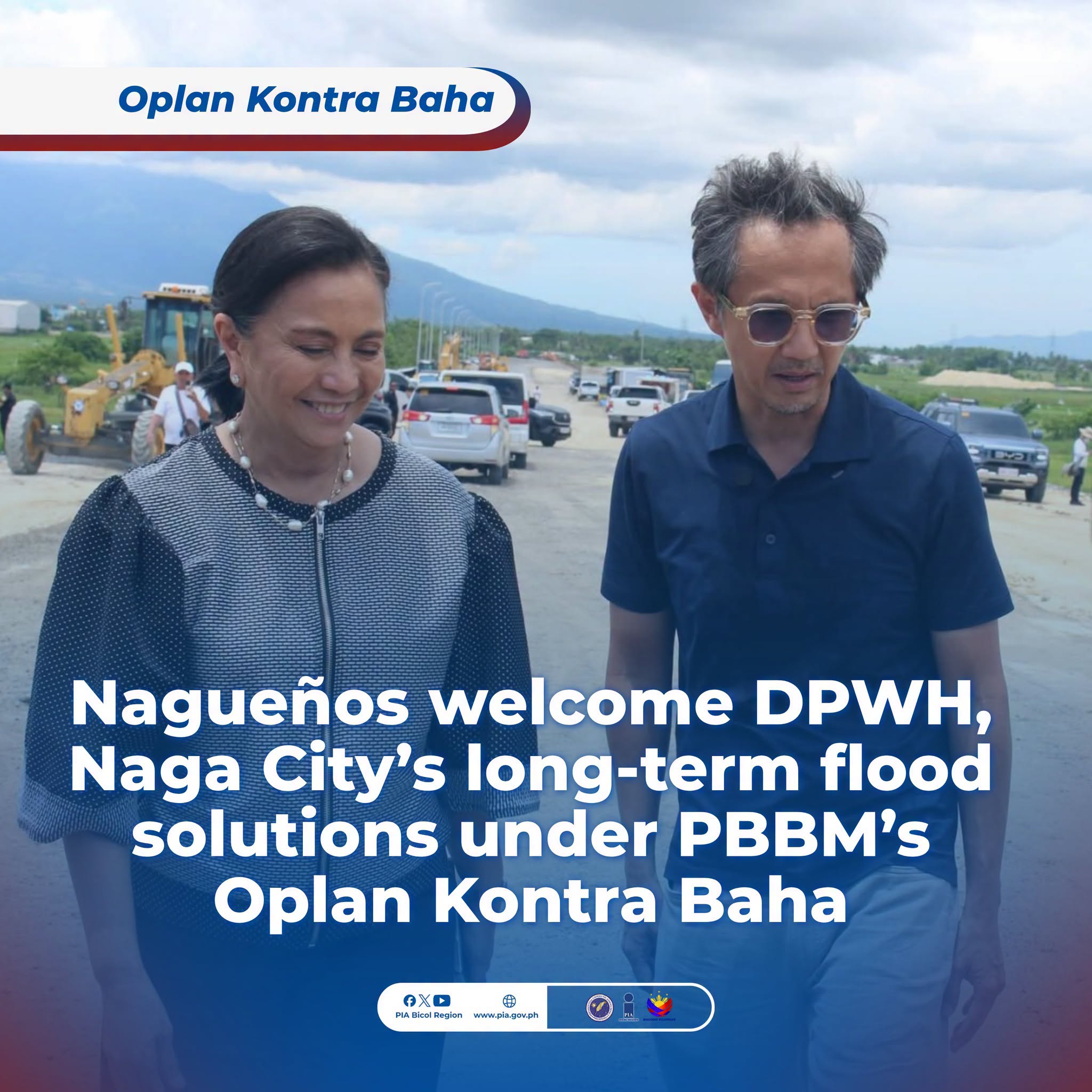
As intermittent rains continue to affect Naga City and neighboring municipalities in Camarines Sur, many residents said they are hopeful that the government’s long-term flood mitigation projects under President Ferdinand R. Marcos Jr.’s Oplan Kontra Baha will finally provide lasting relief from recurring floods.
For Samuel Rito, a pedicab driver and resident of Zone 5 in Barangay Concepcion Pequeña, flooding has become an all-too-familiar concern whenever heavy rains begin.
“Diit lang na uran, talagang nababaha na igdi,” Rito said, pointing to clogged drainage systems and waterways that, according to him, contribute to flooding in their community.
(Even light rain is enough to cause flooding here.)
Rito shared that flooding disrupts the daily lives of residents, making it difficult for people to travel, report for work, attend school, and carry out everyday activities whenever roads become submerged. Like many Nagueños living in flood-prone communities, Rito said he is optimistic that the Department of Public Works and Highways (DPWH), in partnership with the Naga City government, will be able to implement sustainable flood control measures that will reduce flooding and improve the city’s resilience against extreme weather.
Rito said regular cleaning of drainage systems and the surrounding environment could help ease flooding, particularly by preventing garbage from blocking the flow of water.
Like other Nagueños who witnessed the city government and DPWH’s efforts, he said he believes that the government’s flood mitigation measures and sustained projects could benefit communities across the city.
During a site inspection in the city on June 20, DPWH Secretary Vince Dizon reaffirmed the agency’s commitment to continue dredging operations in the Naga River and Sagop Creek, as well as cleaning major waterways and drainage systems as part of long-term efforts to address recurring flooding.
“Ang commitment namin kay Mayor Leni, all year round na ang dredging at cleaning of waterways sa iba’t ibang lugar,” Dizon said.
(Our commitment to Mayor Leni is that dredging and cleaning of waterways will be done all year round) Mayor Leni Robredo said many flood-prone areas in the city drain through Sagop Creek, which can no longer accommodate large volumes of water during heavy rains and typhoons.
“Kapag maulan, lalo na kapag bagyo, kahit malinis siya, hindi niya kaya,” Robredo said, referring to Sagop Creek.
(Even if canals and drains are kept clear, water still overflows when it rains hard or when a typhoon hits.)
𝐏𝐫𝐨𝐩𝐨𝐬𝐞𝐝 𝐢𝐧𝐭𝐞𝐫𝐯𝐞𝐧𝐭𝐢𝐨𝐧
To improve water flow, the DPWH and the city government are working together to rehabilitate and reopen waterways that will allow floodwaters to flow directly into the Bicol River instead of passing through congested tributaries and drainage channels.
“Kapag binuksan ito, ito na ang magiging outfall niya. Diretso na siya sa Bicol River. Hindi na siya dadaan sa tributaries at hindi na rin siya dadaan sa Sagop Creek,” Robredo said.
The project is expected to benefit flood-prone communities, particularly those near Julian B. Meliton Elementary School in Barangay Concepcion Pequeña, which frequently experiences flooding.
“Kawawa ‘yung mga bata kasi hindi na nila magamit ‘yung school,” Dizon said, adding that he instructed DPWH Regional Director Khadaffy Tanggol to fast-track the completion of the project.
“Imbes na sa Sagop Creek mapunta, diretso na rito at lalabas na sa Bicol River. Hopefully, bibilis ang daloy ng tubig sa area na iyon,” he added.
Dizon said President Marcos directed the agency to prioritize projects identified by local government units to address long-standing infrastructure and disaster-related concerns.
Meanwhile, Jiro Castillo, an incoming third-year AB Communication student from Barangay Liboton, Naga City, said infrastructure improvements should make streets safer and more accessible, especially for students and commuters.
During the inspection along M.T. Villanueva Street, Castillo personally raised his concerns with Dizon and Robredo, saying walking along the street can be difficult during hot afternoons because sidewalks are obstructed and traffic builds up around nearby schools.
“There are times na sa sobrang init—usually kunwari ‘pag ang pasok ay hapon or lunch—sakto talaga sa buong sidewalk and halos walang malakaran the whole street ng M.T. Villanueva,” he said.
He said the area serves students from several schools, making safer sidewalks, better traffic management and more accessible public spaces important.
“For a more walkable Naga City, or for a more walkable street in Liboton,” he said. “As someone na mahilig din maglakad pauwi, parang mas makakatulong siya sa akin personally. Parang mas mae-enjoy ko ‘yung paglakad along Liboton and walang gaanong obstructions in the way na makaka-hinder sa akin.”
M.T. Villanueva Street will serve as the pilot area in Naga City for an underground cabling facility, which is expected to make the streets safer and more accessible. The National Electrification Administration is collaborating with the DPWH on the project as part of urban mobility improvements.
“Ang gusto lang talaga ng Pangulo ay suportahan ang mga needs ng local government units all over the country,” Dizon said. “We’re doing this not just in Naga but for all other LGUs.”
He added that the DPWH has lined up additional flood control projects for 2027 as part of efforts to further improve Naga City’s flood management system.
Source: PIA Bicol Region