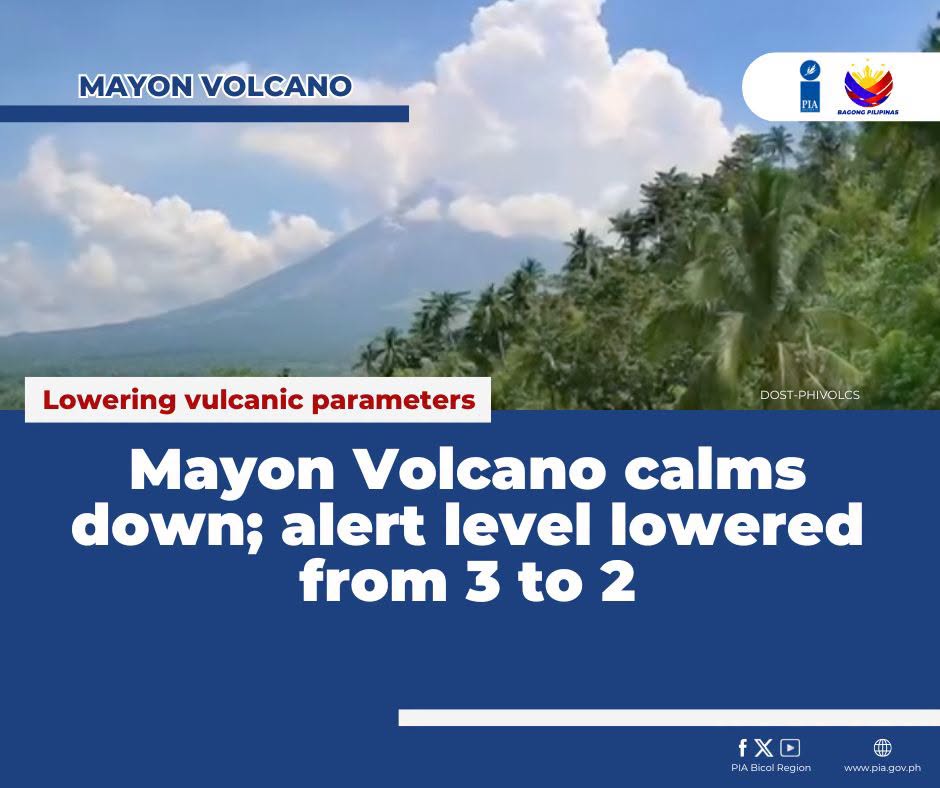
LEGAZPI CITY (PIA) — The Philippine Institute of Volcanology and Seismology (Phivolcs) has lowered Mayon Volcano’s alert level status from 3 (increased tendency toward hazardous eruption) to 2 (moderate level of unrest) on Wednesday.
Alert Level 2 indicates an overall decline from higher activity, but ongoing unrest means an eruption is still possible.
Mayon Volcano had its alert level raised to alert level 3 from 2 on January 6, 2026.
“Mayon Volcano’s monitoring network and observation of day-to-day conditions have recorded a general decline in unrest since 23 July 2026,” Phivolcs said in a bulletin.
The parameters mentioned by Phivolcs include the Strombolian events, lava effusion and lava collapse-fed rockfall and pyroclastic density currents (PDCs), which have declined; earthquake activities, which have declined to an average of 13 events per day since July 23; lower sulfur dioxide gas emissions averaging 2,163 tons per day; and a small decrease in the ground level in the eastern part of the volcano.
While the volcanic edifice has remained generally asymmetrically inflated since January 2025, a short-term net deflation has been recorded in the eastern part of the volcano, according to Phivolcs.
Phivolcs said that even though the alert level for the volcano has been decreased, this doesn’t mean that the volcanic activity has stopped.
The volcano is still under a lot of pressure, and it continues to release higher amounts of gas than normal, the agency added.
“Thin ashfall could also be experienced downwind of the Mayon edifice in the event of minor explosions, phreatic eruptions or lava collapse-fed PDCs,” Phivolcs said.
“Given the large amounts of volcanic material deposited by the 2026 eruption, heavy to intense rainfall could generate post-eruption lahars and sediment-laden streamflow in channels draining the Mi-isi, Bonga and Basud gullies,” it added.
Phivolcs cautioned the public against entering the volcano’s 6-kilometer-radius permanent danger zone due to the ongoing threat of sudden minor explosions or phreatic eruptions.
These events could generate volcanic hazards such as short-range PDCs, rockfalls, ballistic projectiles, and landslides, the agency added.
Source: PIA Bicol