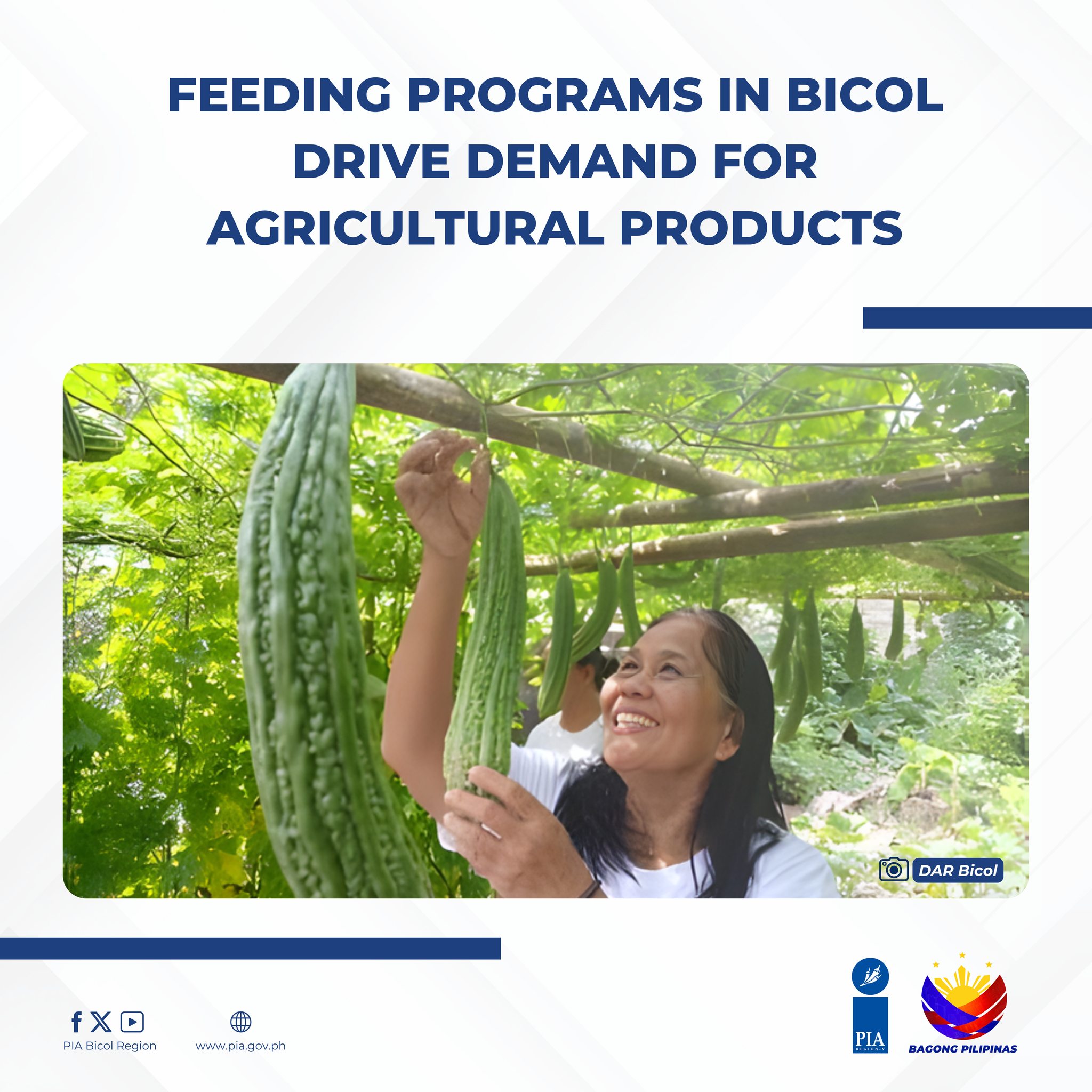
LEGAZPI CITY (PIA) — The expanding feeding programs in the Bicol region have significantly increased demand for products from local farms, according to the Department of Social Welfare and Development (DSWD).
Grace Molina, the Enhanced Partnership Against Hunger and Poverty (EPAHP) coordinator for Bicol, said on Tuesday that market access is no longer a challenge for small-scale farmers and fisherfolk in the region.
Molina emphasized the need for more farmers and fisherfolk to organize themselves into community-based organizations (CBOs) under EPAHP to meet the rising demand.
“The market for our institutional feeding programs within the government has grown tremendously,” Molina noted in an interview on DSWD Singko.
She said that the EPAHP, led by DSWD, has enhanced food security by connecting local farmers, fisherfolk, and food producers to larger markets.
This initiative not only helps secure their incomes but also increases people’s access to nutritious food, she added.
Molina said that the partner agencies of DSWD in the EPAHP have assisted local farmers, fisherfolk, and food producers in forming 84 community-based organizations (CBOs) and cooperatives that now supply food to agencies implementing feeding programs.
“Those with institutional feeding programs are the ones who need nutritious agricultural products produced by CBOs,” Molina said, speaking in English and Filipino.
These institutional buyers include the DSWD, the Department of Education (DepEd), the Department of Health (DOH), local government units (LGUs), the Bureau of Jail Management and Penology (BJMP), and the Commission on Higher Education (CHED).
The DSWD, DepEd, and LGUs purchase products in bulk for their supplemental feeding programs aimed at undernourished children.
Meanwhile, the DOH Bicol and BJMP Bicol buy agricultural products to provide meals for patients and incarcerated individuals.
Additionally, CHED Bicol has adopted a policy of purchasing local farm products to serve during its meetings and conferences as a way to support local farmers.
Molina said that the EPAHP initiative, which involves 34 organizations consisting of both national and international partners, aims to eliminate hunger through sustainable agriculture and enhanced access to food and nutrition, particularly for vulnerable communities.
As part of this strategy, the initiative plans to connect CBOs with large enterprises like supermarkets, food processing companies, and restaurant chains, she said.
However, she noted that currently, the products from CBOs are primarily supplied to government institutions.
“The demand is too much for our CBOs; they cannot meet the large volume required for government institutional feeding programs,” she said. (PIA Bicol)
Source: PIA Bicol