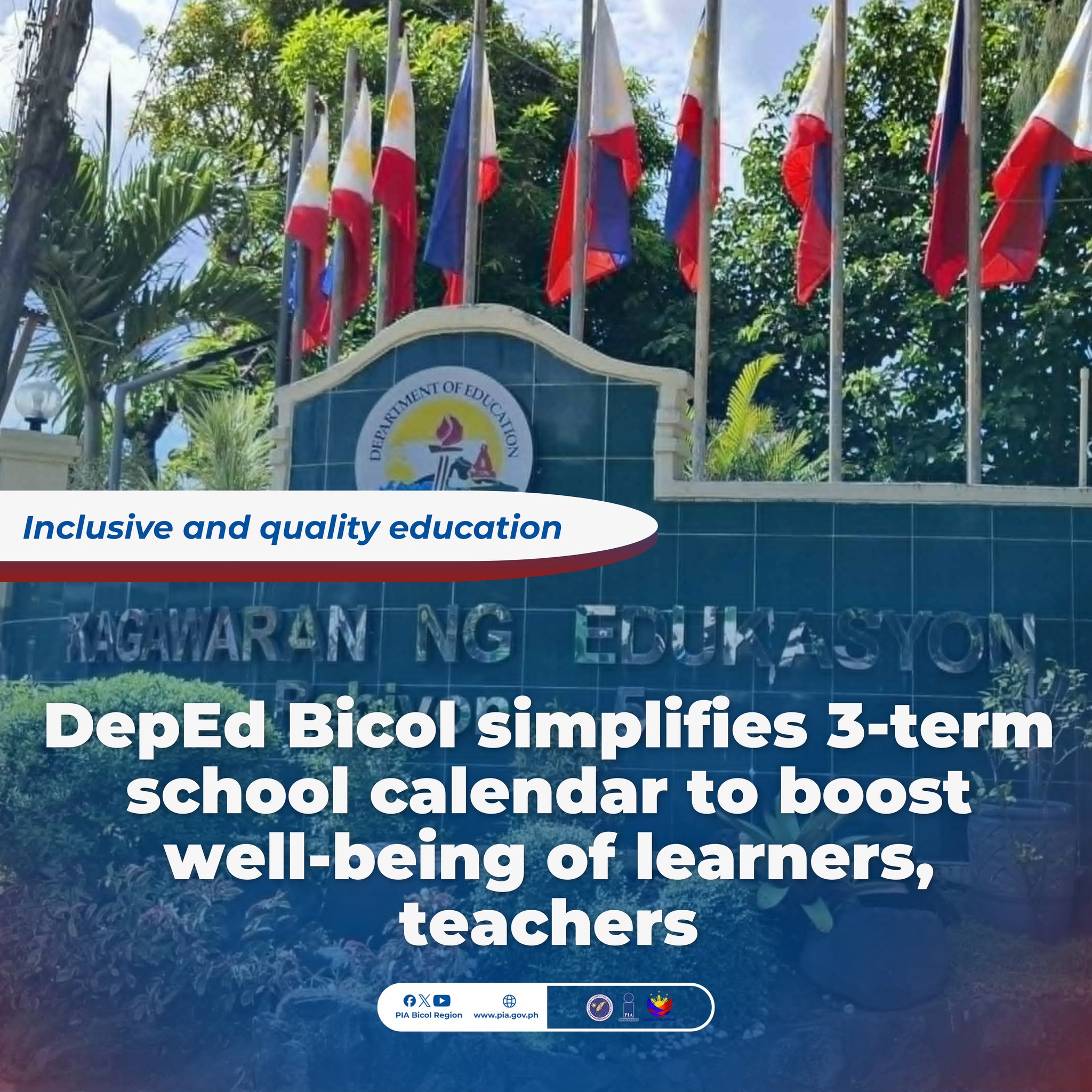
LEGAZPI CITY (PIA) — The Department of Education (DepEd) in the Bicol region is implementing a simplified three-term school calendar for School Year 2026–2027, focusing on improved learning continuity and well-being for students and teachers.
Changes to the school calendar can often be confusing for parents and students. But according to DepEd Bicol officials, the new system is designed to be easy to follow while addressing persistent challenges in classroom delivery.
More balanced
Grace Rabelas, chief of the Curriculum and Learning Management Division of DepEd Bicol, said that the school year is now divided into three academic terms, each with defined phases that balance instruction, assessment, and rest.
The school year opens with Term 1, beginning June 8, 2026. Its first four days—referred to as the “opening block”—are dedicated to non-academic but essential activities such as classroom orientation, baseline assessments, and parent-teacher engagement.
“This period allows teachers and learners to build rapport and prepare for the learning process. It sets the tone for a more organized and focused school year,” Rabelas said.
Following the opening block, there will be a 54-day instructional period during which uninterrupted classroom teaching will take place. The term will conclude with a 10-day end-of-term block, which includes wellness breaks, school-based activities, and time for teachers to finalize student assessments.
Terms 2 and 3 will follow a similar structure but will begin directly with instructional days, eliminating the need for another opening block.
Term 2 will run from September to December 2026, while Term 3 will cover January to April 2027.
According to DepEd, this new design will help minimize overlapping activities, a long-standing concern that often disrupts lesson flow and impacts learning outcomes.
Focus on learning
In addition to the calendar revision, DepEd is also implementing reforms in student assessment and recognition systems to align them with a more holistic approach to education.
For Grades 1 to 3, the department will utilize descriptive ratings instead of numerical grades, emphasizing the development of foundational skills over ranking performance.
For Grades 4 to 12, a combination of numerical and descriptive grading will be adopted, with a gradual move toward eliminating the “transmutation system”—a grading adjustment method—by the 2027–2028 school year. This change will ensure that student report cards more accurately reflect actual performance.
The awards system is also being restructured. Academic awards will no longer be given in Grades 1 to 3, placing greater emphasis on behavioral development and values formation.
For higher grade levels, academic awards will be maintained, but rankings will be eliminated; recognition will be awarded in alphabetical order instead of using titles like valedictorian and salutatorian.
“This approach fosters a healthier learning environment. We want to encourage growth and mastery rather than unhealthy competition,” Rabelas emphasized.
To ensure a smooth implementation, DepEd has conducted a series of training sessions and orientations for school heads, supervisors, and teachers in May 2026, in accordance with DepEd Order 9, series of 2025.
Continuous reorientation and support will also be provided to ensure consistency in classroom practices across the region.
DepEd stressed that these reforms are not just about changing schedules, but about transforming how learning occurs in schools—making it more focused, resilient, and responsive to the needs of students.
Better outcomes
At its core, the three-term system aims to address issues such as learning loss, disrupted instruction, and student fatigue, which have been exacerbated by frequent interruptions—whether due to natural disasters or other external factors.
By structuring the school year into manageable learning cycles, DepEd hopes to improve student mastery, enhance teacher effectiveness, and promote mental wellness in schools.
“The goal is to create a more conducive learning environment—one that supports both academic achievement and well-being,” Rabelas concluded.
As the new school year approaches, Rabelas urges parents, teachers, and communities to collaborate in supporting this transition, ensuring that every learner benefits from a system designed not only for performance but also for sustainable and meaningful education.
Source: PIA Bicol