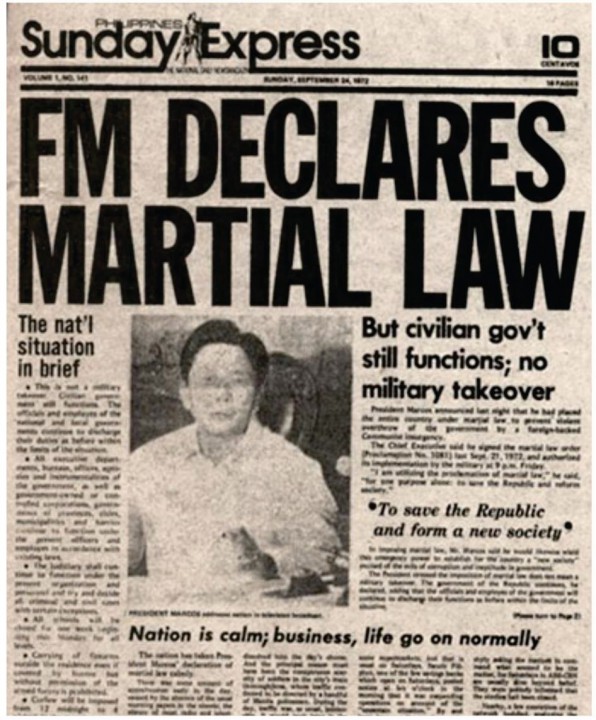
THE Philippine economy under Martial Law barely grew 6 percent when most of its Asean peers were growing at 7 percent, according to a study done by economists from the University of the Philippines School of Economics (UPSE).
In the Discussion Paper titled, “Martial law and the Philippine economy,” the authors led by former UPSE Dean Emmanuel de Dios said the average GDP growth rate between 1972 and 1985 was only 3.4 percent. For the period of Martial Law, between 1972 and 1980, the growth was at 5.98 percent.
This was only due to the “exceptional years” of 1973 and 1976 which posted growth of 8.9 percent and 8.8 percent, respectively. The economists noted that while public sector fixed investment increased to 6.5 percent of GNP between 1972 and 1976, tax revenues remained virtually unchanged.
“It may be false-memory syndrome, confusion due to social media, or perhaps the way the period is treated in the schoolbooks, but a generation or more of Filipinos has somehow been reared to regard the martial law period [1972 to 1981] as the ‘golden years’ of the Philippine economy,” the economists said.
“But just as it is unfair to evaluate a pupil based on one or two quizzes, so it is anomalous to judge an entire historical period based only on a few years’ performance. Viewed from a longer and comparative perspective, the remarkable economic numbers for just those two years (1973 and 1976), or even the martial law period itself, are the notable exceptions rather than the rule,” they explained.
Further, the authors said careful examination of the data from the dictatorship years and the period under democratic government showed there was faster GDP growth under the democratic years at around 4.03 percent between 2009 and 2017 than the 3.17 percent in the 1972 to 1980 period.
The same results were reached when the economists compared the two decades of the Marcos regime and the last two decades under democratic government.
Data showed that in terms of GDP growth, the growth in the last 20 years, including the Duterte administration, grew 4.89 percent while the two-decade Marcos era only allowed GDP to grow 3.83 percent.
Further, comparing the growth of GDP per capita in the last 20 years yielded an average growth of 3.04 percent, significantly higher than the 1.09 percent in the two-decade rule of Marcos.
De Dios and other economists also noted that real per capita incomes declined in 1982 and it took 20 years for the economy to recover from these lower incomes.
“The deeper question in assessing economic performance under martial law, however, is why growth performance could not be sustained. The important distinction between recent growth and that under martial law was that these ‘best years’ of dictatorship were followed by a period of crisis and collapse, from 1982 to 1985,” the economists said.
“Real per capita incomes dropped in 1982 and were not regained until 2003, resulting in ‘two lost decades of development.’ By contrast, there are [thus far, anyway] no indications of a catastrophic end to the growth observed over the past decade,” they added.
Combination of factors
However, the authors said the state of the economy under Marcos, including during Martial Law, was not entirely due to “political factors.” The economists said it was brought by “bad luck, bad policy, [and] bad faith.”
Bad luck was a factor because of concerns that were beyond the control of the national government at that time, such as the oil-price shocks of 1974 and 1979 which greatly swelled the country’s import bill.
This led the government to have “no choice” but to engage in heavy borrowings to prevent the economy from tanking. The UPSE group said the country became a “victim of the global panic of commercial creditors following the Mexican default.”
This bad luck, unfortunately led to bad policies. At the time the country encountered the oil price shocks and increased its borrowings, the authors said the Philippines was “rapidly digging a debt hole,” especially after 1974.
At this time, the authors said international reserves fell continuously from 50 percent of total external debt to 20.2 percent between 1974 and 1977. They said this would further deteriorate to 13.7 percent in 1981 and to only 3.5 percent by 1983.
However, short-term debt climbed to 92 percent of international reserves in 1976 from 52.9 percent in 1974. It kept climbing to 183.5 percent in 1978. “This meant that the country had to increasingly resort to short-term borrowing to remain liquid.”
Given the country’s economic woes due to unsustainable borrowings, it was only a matter of time before investors would lose faith in the economy, thus the phenomenon known as capital flight.
The authors said the estimated capital flight under the dictatorship between 1973 and 1986 was $9.7 billion in nominal terms and $11.3 billion in real terms—or 34 percent and 40 percent, respectively, of the $28.36-billion total external debt outstanding by 1986.