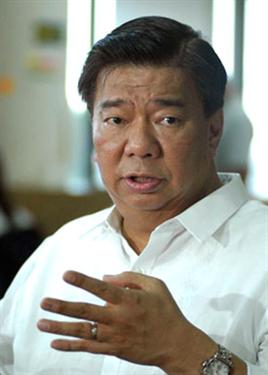
THE country’s economy is “paying a hefty price” for the administration’s anemic response to effectively contain the Covid-19 pandemic and its failure to close boders to China in timely fashion, Senate Minority Leader Franklin Drilon said Wednesday.
The opposition Senator foresees the next administration in 2022 “facing a hefty debt burden and the problems of a shrinking economy and rising unemployment rate and hunger due to mismanagement of the Covid-19 pandemic.”
In a televised interview, the lawmaker pinned the blame on “mismanagement by the Department of Health of the pandemic responses,” noting such bungling led to the rising Covid cases “that caused the collapse of the economy, forcing thousands of businesses to close down and leaving millions of Filipinos jobless.”
Drilon said, “Let me emphasize that where we are today is the result of the mismanagement of the DOH [Department of Health] of our pandemic responses,” adding: “Our original sin, if I may call it as such, is when we refused to close our borders on China.”
He recalled the earlier refusal of Health Secretary Francisco Duque III to “close the Philippine borders on Chinese early last year to prevent the spread of the virus” in the country despite mounting calls by various sectors.
The lawmaker said “the reason …the country is lagging behind in terms of the availability of the vaccines is…the failure to secure the much-needed doses early by making advanced payments with vaccine manufacturers. “The inoculation is very slow. At the rate we are going, I don’t know when we can achieve herd immunity.”
He foresees the next administration will be burdened by both the short-and long-term impacts of the pandemic, citing for instance, the record high of P10.9-trillion national debt as of April. He noted that the national outstanding debt increased by roughly P3.2 trillion during the pandemic from approximately P7.73 trillion in 2019.
“This is a burden to the next administration,” said Drilon, adding: “I don’t know why they want to run for President [when] we have this hefty debt.”
Still, he affirmed support for government options on borrowings to finance the Covid-19 response, recalling that the Finance secretary made assurances that the debt level “remains manageable.”
He worried, however, that the national debt may continue to increase as government will have to resort to more borrowings to finance its Covid-19 response, including the purchase of vaccines—given the fact that the Philippine economy has been in the longest recession since the 1980s—and the low tax collections.
Drilon noted the economy shrank by 4.2 percent during the first quarter of this year and recorded a full-year 2020 economic contraction of 9.5 percent, as he recalled that the World Bank recently downgraded its Philippine economic growth forecast to 4.7 percent from the previous forecast of 5.5 percent.
“Our economy is shrinking. About 4.14 million people lost their jobs in April. About 21 percent of Filipino families experienced involuntary hunger,” he said.
At the same time, Drilon described as a “pipe dream” the Duterte government’s economic projection that the Philippine economy will be able to recover starting the second quarter of 2022. “I don’t believe that. Even with the election spending in 2022, I don’t think we would be on the road to recovery by the second quarter of 2022. To say that we will be going back to the 2019 economic level by the second quarter of 2022 is a pipe dream.”