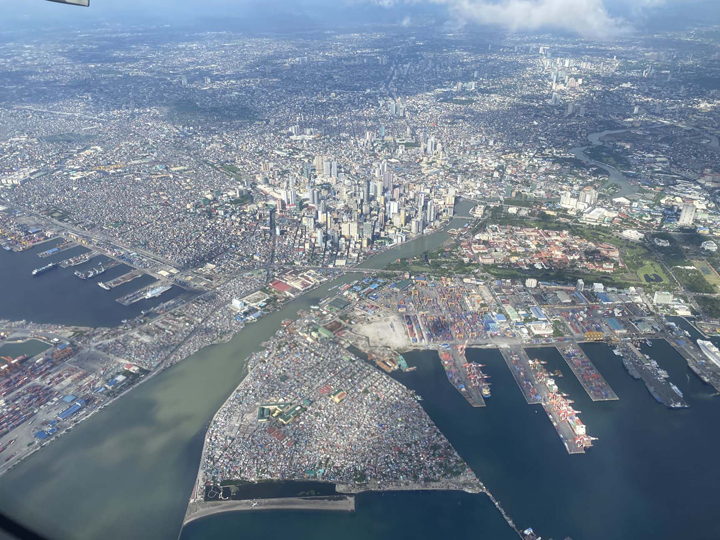
METRO Manila’s economic growth suffered under the weight of the pandemic which caused it to lose P627.7 billion last year, according to the Philippine Statistics Authority (PSA).
In a briefing on the Gross Regional Domestic Product (GRDP) performance of Metro Manila on Thursday, PSA said the GRDP of NCR last year declined 10.1 percent to P5.6 trillion from P6.2 trillion recorded in 2019.
The agency said the lockdowns that had to be put in place to contain the spread of Covid-19 “greatly affected” the performance of Metro Manila last year.
“The economic loss is about P627.7 billion. We should take note that the pandemic started in the latter part of the first quarter, in March, so this really affected the economic output of the region,” PSA NCR Director Paciano B. Dizon said in a briefing on Thursday.
Dizon explained that apart from the pandemic and lockdowns, Taal Volcano’s eruption in January 2020 and the supertyphoons affected NCR.
National Economic and Development Authority (Neda) Regional Development Group Assistant Secretary Greg L. Pineda added that mobility restrictions significantly affected the manufacturing sector.
Pineda said the NCR is a crucial part of the Philippine economy and plays an important role in the growth of two other regions—Central Luzon and Calabarzon—that also drive economic growth in the country.
“The interdependence of the three major regions and also the restrictions on physical movement of people created job losses and the income losses. Of course NCR is services-led, its manufacturing [sector] is also crucial in terms of the value in its total economic output. So all these things contributed to the decline in the performance of the National Capital Region for 2020,” Pineda said.
In terms of regional performance for Services in 2020, the National Capital Region (NCR) registered the biggest share of 42.6 percent, followed by Calabarzon and Central Luzon at 10.7 percent and 8.2 percent, respectively.
In terms of each region’s share to the whole industry, Calabarzon constituted the largest share at 24.5 percent, trailed by NCR, 20.8 percent, and Central Luzon, 14.7 percent.
For Agriculture, Forestry and Fishing (AFF), Central Luzon topped the share at 14.3 percent, followed by Northern Mindanao at 10.0 percent, and Western Visayas at 9.2 percent.
Double-digit declines, too
Meanwhile, PSA data showed that NCR is not the only region in the Philippines that recorded double-digit declines in GDP last year.
Central Luzon or Region 3 actually posted the deepest contraction at 13.9 percent in 2020 while Calabarzon or Region 4-A followed with a decline of 10.5 percent.
Data showed four other regions posted greater contractions in economic growth relative to the national average of 9.6 percent in 2020.
Besides NCR, Central Luzon, and Calabarzon, the regions that posted significant declines in GDP, said PSA, are the Cordillera Administrative Region, Cagayan Valley, and Central Visayas which all posted a contraction of 9.9 percent. Western Visayas also posted a deep contraction of 9.7 percent in 2020.
Regions that posted the smallest contractions last year were the Bangsamoro Autonomous Region in Muslim Mindanao (BARMM) with a decline of 1.9 percent; Soccsksargen, 4.3 percent; and Northern Mindanao and Zamboanga Peninsula both at 5.2 percent.
In terms of industry, the accommodation and food services sector posted the deepest contraction at 45.4 percent followed by other services with a decline of 41.1 percent.
Sectors that also posted a decline of above 20 percent were transportation and storage at 30.9 percent and construction, 25.7 percent.
Only three sectors posted growth in 2020. These are the financial and insurance sector with a growth of 5.5 percent, followed by information and communication at 5 percent and public administration and defense and compulsory social activities, 4.6 percent.