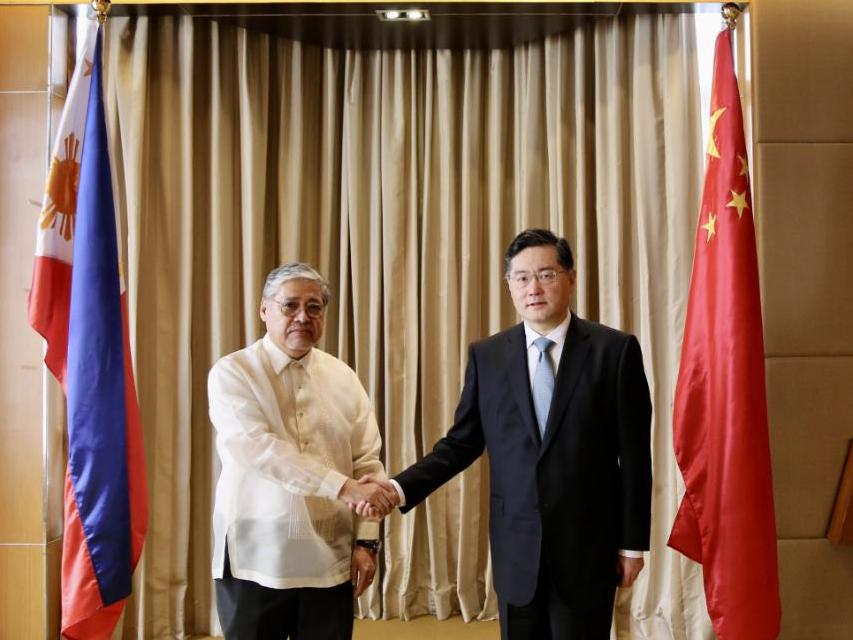
“Let’s resolve our differences in the spirit of ‘credibility, consultation and dialogue’.”
Chinese State Councilor and Foreign Minister Qin Gang said this in his opening remarks during the bilateral meeting with Philippine Foreign Affairs Secretary Enrique Manalo Saturday (April 22).
Qin is in Manila upon invitation of Manalo, to follow up on agreements made between Philippine President Ferdinand “Bongbong” Marcos Jr. and Chinese President Xi Jinping during the former’s state visit to Beijing last January 2023.
Qin’s visit comes on the heels of simmering tension between the United States and the Philippines, and consequently, the Philippines allowing the US more access to its military facilities near Taiwan Strait.
“We need to work together to continue our friendship, deepen mutually beneficial cooperation, and properly resolve our differences in the spirit of credibility, consultation, and dialogue. And keep our promises to one another,” Qin said, speaking through an interpreter.
There was no opportunity for the media to question the visiting Chinese diplomat on his emphasis on “credibility” and “keeping promises to one another.”
However, recently, Chinese Ambassador to Manila Huang Xilian has expressed fears over the recent addition of locations under the Philippine-US Enhanced Defense Cooperation Agreement (EDCA).
“The US intends to take advantage of the new EDCA sites to interfere in the situation across the Taiwan Strait to serve its geopolitical goals, and advance its anti-China agenda at the expense of peace and development of the Philippines and the region at large,” Ambassador
Huang had said during the Manila Forum last April 16.
On Friday, in a forum in Shanghai, Foreign Minister Qin also specifically mentioned Taiwan and did not mince words, warning countries who support Taiwan’s independence bid.
“Those who play with fire on the question of Taiwan will burn themselves,” he said.
Qin sounded more calculating in his statement in Manila, giving broad hints that “a healthy and stable” Philippine-China bilateral relationship benefits the entire Asia-Pacific region.
“Amid the fluid and turbulent national and regional situations, a healthy and stable China- Philippine relationship is not only meeting the aspiration of our two people but also in line with the aspiration of the regional countries,” he added.
Manalo, meanwhile, said both countries need to “manage” their territorial conflict in the South China Sea especially with regard to the access of Filipino fishermen in the disputed waters.
“Our leaders have agreed that our differences in the West Philippine Sea are not the sum total of our relations. These differences should not stop us from seeking ways of managing them effectively, especially with respect and enjoyment of the rights of Filipinos especially
fisherfolk whose livelihood is undermined by incidents by the actions in the West Philippine Sea,” the Philippine diplomat said.
Manalo said he intends to work “very closely” with Qin in improving economic relations. China is the Philippines’ top trading partner.
He said China’s investment pledges worth US$22.8 billion made during Marcos’ state visit in January 2023 “are slowly being realized.”
The Philippines intends to strengthen more economic cooperation with China in agriculture, infrastructure development, energy, and science and technology. Manalo said the recent revival of tourism and resumption of flights between the Philippines and China has contributed to improving people-to-people linkages between Filipinos and Chinese.
“I hope this meeting will give us an opportunity to follow through on our country’s recent high-level interaction and make some headway in addressing common issues and strategies,” Manalo added.