
LONDON—Prize money will double for the Women’s European Championship but will be less than 4 percent of the riches paid out for the most-recent men’s tournament.
European governing body UEFA announced Thursday that the 16 women’s teams at Euro 2022 in England will share 16 million euros ($19 million), while €4.5 million ($5 million) will go to clubs who release their players.
The 24 teams at the men’s European Championship shared 371 million euros ($435 million) in UEFA prize money this year, but clubs were also guaranteed at least €200 million ($235 million) for the release of players.
That means while at least €571 million ($670 million) is allocated in the financial package for the men’s tournament, only €20.5 million ($24 million) has been set aside for the women’s showpiece.
After the decision of its executive committee, UEFA said it was “ensuring that more money than ever before is distributed across the women’s game.” The committee features only one woman—French Football Federation General Manager Florence Hardouin—alongside 19 men.
The prize money is a reflection of the disparities in the revenue generated by the men’s game compared to women’s competitions.
The Women’s European Championship is being hosted by England next July after being delayed by a year due to the pandemic.
Fifa has faced long-standing criticism for the inequity in funding between the men’s and women’s game.
The global governing body awarded $400 million in prize money for the 32 teams at the 2018 men’s World Cup, including $38 million to champion France. It awarded $30 million for the 24 teams at the 2019 Women’s World Cup, including $4 million to the Americans after their second straight title.
Fifa has increased the total to $440 million for the 2022 men’s World Cup and is looking to double the women’s prize money to $60 million for the expanded 32-team 2023 Women’s World Cup.
Mexico’s anti-monopoly commission, meanwhile, announced Thursday it has fined 17 soccer teams for conspiring to impose a cap on the salaries of women soccer players.
The commission said the teams will be fined about $9 million for illegal practices.
The clubs acted somewhat openly through the Mexican Soccer Federation, and the commission said the effect was “to deepen even further the salary gap between male and female soccer players.” Those named by the commission included Mexico’s top soccer teams.
The salary cap appears to have been in place since Mexico’s women’s soccer league was formed in 2016. The wage cap was apparently increased in 2018, and continued through 2019.
Another agreement between teams included limits on players’ ability to switch teams and get higher salaries.
The US Soccer Federation, on the other hand, has urged the 9th US Circuit Court of Appeals to uphold a lower court’s decision to throw out the wage discrimination portion of a lawsuit filed by members of the women’s national team, arguing the law doesn’t require the federation to pay the players “tens of millions of dollars in phantom revenue it never received.”
In a 59-page brief filed Wednesday with the appellate court in San Francisco, the USSF said US District Judge R. Gary Klausner in Los Angeles correctly granted a summary judgment to the federation on the pay claim in May 2020. The judge ruled the women rejected a pay-to-play structure similar to the one in the men’s agreement with US Soccer and accepted greater base salaries and benefits than the men. He allowed their allegation of discriminatory working conditions to go to trial, and the sides reached a settlement on that portion.
The women asked the 9th Circuit to overrule the trial court’s ruling and put their wage claim back on track. A three-judge panel is likely to hear oral arguments late this year or in early 2022.
The women’s team players “deliberately negotiated for a CBA that prioritized guaranteed salaries and substantial benefits over higher contingent bonuses,” the federation’s lawyers wrote. “Plaintiffs cannot now, with the benefit of hindsight, pursue ‘equal pay’ claims based on a different pay structure they explicitly rejected. The District Court agreed. This is not a factual dispute. It is not a battle of the experts. It is a fundamental disagreement about what equal pay means under the law.”
The USSF recently said it has offered identical contracts to both unions, which are separate and have no obligation under federal labor law to agree to similar terms. The federation said the two unions had declined to negotiate a single agreement.
Items currently in the women’s contract, such as pay for players in the National Women’s Soccer League, maternity and pregnancy leave and pay, and medical and health insurance, would not necessarily be dropped from USSF proposals, the federation said.
The governing body also said it would refuse to agree to a deal in which World Cup prize money is not equalized. AP
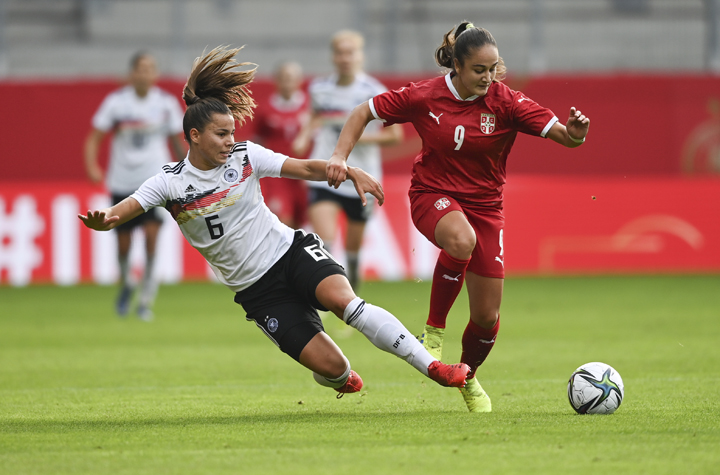
Image courtesy of AP