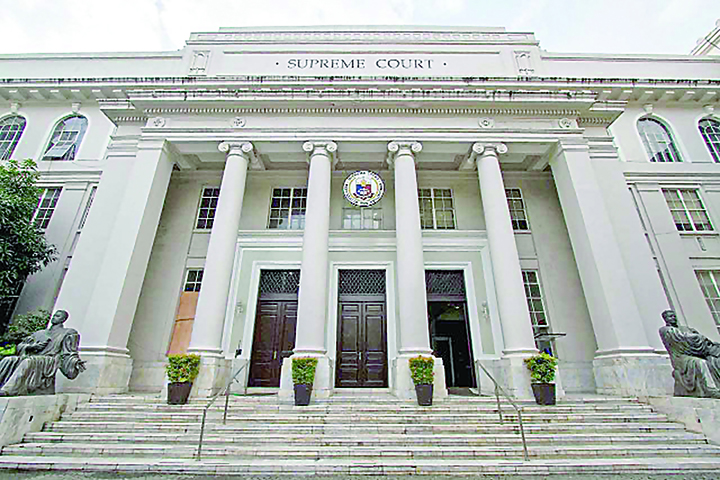
THE Supreme Court (SC) has decided to lift the freeze order issued by the Court of Appeals (CA) on the properties and monetary instruments of a brother-in-law of retired military comptroller Lt. Gen. Jacinto Ligot, who is undergoing trial before the Sandiganbayan for allegedly amassing ill-gotten wealth.
Meanwhile, in a separate decision penned by Associate Justice Marvic Leonen, the Court’s Third Division has directed the Sandiganbayan to implement its December 16, 2010 resolution, approving retired Major General Carlos F. Garcia’s request for bail following a plea bargaining agreement with the Office of the Ombudsman in 2010 involving his plunder and money laundering cases.
The SC also lifted the temporary restraining order (TRO) it issued in 2013 enjoining the Sandiganbayan from continuing its proceedings pertaining to the plea bargaining agreement.
The Court issued the orders after it dismissed the petition filed by the Office of the Solicitor General (OSG) seeking to intervene in the agreement, citing its “mandate to protect and promote the interests of the people.”
The OSG expressed belief that the plea bargaining agreement brokered by the Office of the Special Prosecutor under then Ombudsman Merceditas Gutierrez’ control, was disadvantageous to the government and public welfare since it allowed Garcia to plead to a lesser offense despite the strong evidence against him.
Thus, the OSG insisted that it is obliged to correct the Ombudsman’s error.
But the SC declared that the OSG has no power of control over the Office of the Ombudsman, the latter being an independent constitutional body.
It further held that the OSG “overstepped” its mandate by insisting on providing additional representation.
“The government was already rightfully represented by the Office of the Ombudsman in the plunder case before the Sandiganbayan,” the SC said.
“Further, the Office of the Solicitor General had no power of control or supervision over the Office of the Ombudsman, an independent constitutional body. It had no authority to impose on the latter’s handling of the Plea Bargaining Agreement, even if it strongly believed that the Plea Bargaining Agreement was grossly disadvantageous to the government and the people’s welfare,” the High Tribunal added.
The Court added that it would not interfere with the substance behind the plea bargaining agreement, since it is within the Ombudsman’s mandate of investigating and prosecuting erring government employees.
“The acceptance of a plea bargain is purely upon the discretion of the prosecutor, while the approval of the plea bargain is subject to the judicial discretion of the court trying the facts. Hence, any review of a plea bargain approved by the Office of the Ombudsman would be tantamount to an appeal on a question of fact and not the proper subject of a petition for certiorari,” the Court said.
The SC explained that the mandate to represent the government in the proceedings before the Sandiganbayan generally lies with the Ombudsman with the exception of the Marcos ill-gotten wealth cases where the OSG was allowed to prosecute a case before the anti-graft court and only in representation of the Presidential Commission on Good Government (PCGG).
Garcia was criminally charged with separate cases for plunder and money laundering for allegedly conspiring with co-accused, including family members, to amass alleged ill-gotten wealth in the form of funds, landholdings and other real and personal properties in the aggregate amount of over P303.2 million.
Only Garcia was arraigned for both cases, which were eventually consolidated, to which he pleaded not guilty.
In 2010, Garcia entered into a plea bargaining agreement with the Office of the Special Prosecutor, which was approved and signed by Gutierrez.
In the agreement, Garcia withdrew his plea of not guilty to the crime of plunder and offered to enter a plea of guilty to the lesser offense of indirect bribery.
He also offered to enter a plea of guilty to the lesser offense of facilitating money laundering as he withdrew his not guilty plea to the money laundering charges.
As part of the deal, Garcia offered to cede P135,433,387.84 worth of cash, real and personal properties owned by him and his family in favor of the government.
On December 16, 2010, Garcia then pleaded to a lesser offer of direct bribery and violation of Section 4 (b) of RA 9160 or facilitating money-laundering.
That same day, upon his motion, Garcia was allowed by the Sandiganbayan to post bail in the amount of P30,000 per case or P60,000 in total.
In the case of Ligot’s brother-in-law Edgardo Yambao, the Court held that the lifting of the freeze order covering bank accounts and vehicles under his name is warranted following the Court’s promulgation on November 18, 2005 of A.M. No. 05-11-04-SC or the Rule of Procedure in Cases of Civil Forfeiture, Asset Preservation, and Freezing of Monetary Instrument, Property, or Proceeds Representing, Involving, or Relating to an Unlawful Activity or Money Laundering Offense under Republic Act 9160, as amended, which became effective on December 15, 2005.
The Court noted that it previously granted Ligot, his wife Erlinda and children’s petition seeking to lift the freeze order issued by the CA based on the same ground.
The said rule provides for a summary or post-issuance hearing within the 20-day period of effectivity of a freeze order and the limitation on an extension thereof to a period of not exceeding six months.
On March 6, 2013, the SC’s Second Division agreed with Ligots’ petition contesting the six-month extension of the freeze order that the CA issued on July 5, 2005 and extended through an order issued in September 2005.
“Similarly, here, petitioner filed a motion for reconsideration of the September 20, 2005 CA Resolution extending the July 5, 2005 Freeze Order. Said motion—along with petitioner’s other motions—was only resolved, that is denied, by the CA through the January 4, 2006 Resolution, after A.M. No. 05-11-04-SC had come into effect. Hence, said Rule, likewise, applies to petitioner’s case,” the Court explained in a decision penned by Associate Justice Gaerlan.
However, the Court reiterated that there was probable cause to justify the issuance by the CA of the freeze order against Yambao’s bank accounts and vehicles.
In Yambao’s case, the SC noted that aside from being Ligot’s brother-in-law, the investigation by the Ombudsman revealed that he had no ample income to acquire substantial assets, reinforcing the belief that he was acting as a dummy for the Ligots.
The CA ‘s freeze order stemmed from the June 27, 2005 request of the Anti-Money Laundering Council (AMLC) to freeze the assets of Ligot, who is accused of amassing millions of pesos in ill-gotten wealth while he was comptroller of the Armed Forces of the Philippines (AFP) from July 1999 to March 2001, and not declaring P54,001,217 worth of assets in his Statement of Assets Liabilities and Net Worth.
The Court stressed that its ruling should be “without prejudice to, and shall not affect, the preservation orders, if any, that the Sandiganbayan may have issued over said monetary instruments and properties relative to the forfeiture case against petitioner filed before said court.”