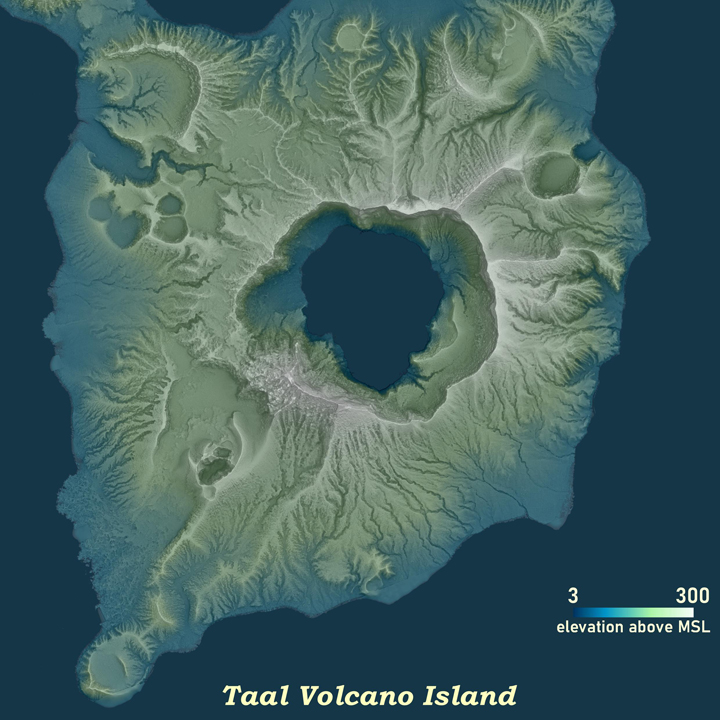
Taal Volcano’s main crater emitted steam-laden plumes that reached 300 meters high, as the volcano continues to demonstrate recurring elevated unrest, the Philippine Institute of Volcanology and Seismology (Phivolcs) said on Tuesday.
One of the world’s most active and smallest volcanoes, Taal last erupted in January 2020, driving tens of thousands of residents around the lake in Batangas to various evacuation centers.
The upswelling of hot volcanic fluids in the main crater lake and active degassing from fumaroles on the main crater were observed since daybreak, according to Phivolcs’ Volcano Bulletin issued at 8 a.m. on Tuesday.
The volcano also emitted an average of 2,214 tons/day of sulfur dioxide on Monday, May 17, 2021.
While Alert Level 2 is maintained over Taal, such activity indicates that the volcano’s condition remain unstable.
At Alert Level 2, sudden steam-driven or phreatic explosions, volcanic earthquakes, minor ashfall and lethal accumulations or expulsions of volcanic gas can occur and threaten areas within and around Taal Volcano Island.
In the past 24 hours, Taal Volcano’s monitoring network recorded 288 volcanic earthquakes, including 39 low-frequency volcanic earthquakes and 249 volcanic tremor events with durations from one to 20 minutes, and low-level background tremor that has been persistent since April 8.
“Most of these earthquakes were very shallow and generated within 5 kilometers beneath Taal Volcano Island or TVI and northeast Taal Lake,” Phivolcs said.
According to Phivolcs, the electronic tilt monitoring recorded slight but very abrupt inflation of Taal Volcano Island that began Monday, while longer-term ground deformation parameters from electronic tilt, continuous GPS, and InSAR monitoring continue to record very slow and steady inflation and expansion of the Taal region that began after the January 2020 eruption, parameters that indicate persistent magmatic activity at shallow depths beneath the edifice.
Phivolcs said entry must be strictly prohibited into TVI’s, Taal’s Permanent Danger Zone or PDZ, especially the vicinities of the main crater and the Daang Kastila fissure, and occupancy and boating on Taal Lake.
Local government units are also advised to continuously assess and strengthen the preparedness of previously evacuated barangays around Taal Lake in case of renewed unrest.
Also, Phivolcs advised civil aviation authorities to caution pilots against flying close to the volcano as airborne ash and ballistic fragments from sudden explosions and wind-remobilized ash may pose hazards to aircraft.