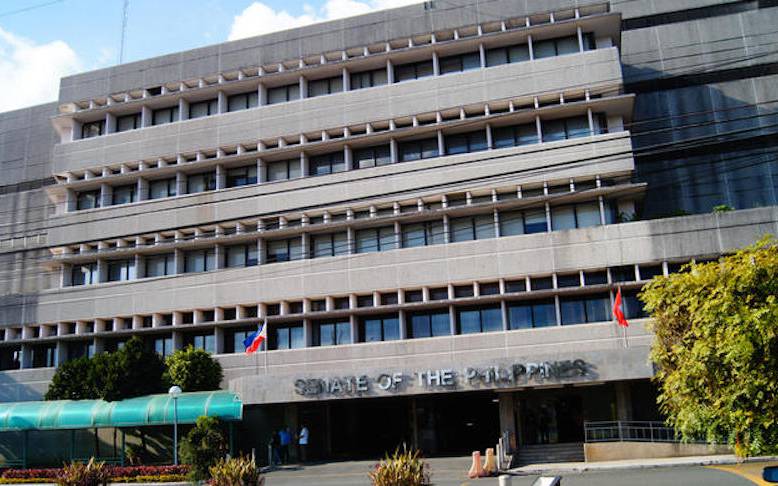
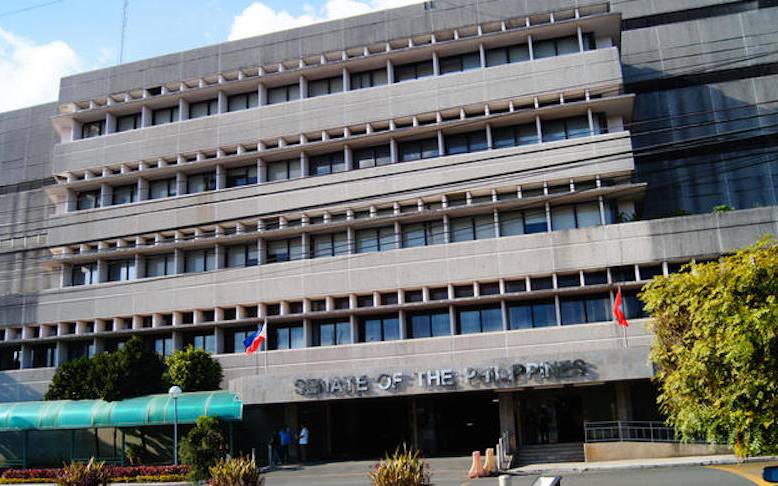
THE Senate headed by Senate President Vicente “Tito” Sotto III on Thursday filed a petition asking the Supreme Court to declare null and void, for being unconstitutional, the memorandum issued by Malacañang Palace prohibiting officials and employees of the Executive branch from appearing in hearings in aid of legislation conducted by the Senate Blue Ribbon Committee.
Executive Secretary Salvador Medialdea issued the memorandum upon the directive of President Duterte, who in recent weeks has attacked the Senate for allegedly using its inquiry powers for political mileage.
In a 67-page petition, the Senate also asked the Court to issue a temporary restraining order and/or a status quo ante order that would compel Executive department officials to attend the ongoing Blue Ribbon hearing on the 2020 Commission on Audit report on alleged questionable procurement of pandemic-related supplies like face masks, shields and Covid-19 test kits.
The petitioner is also asking the Court to prohibit respondent Medialdea and other officers of the Executive branch from issuing and implementing directives to law enforcement agencies such as the Philippine National Police and the National Bureau of Investigation that would obstruct the proceedings of the Senate and withhold assistance in the enforcement of the Senate’s compulsory processes.
The Senate is also asking the High Tribunal to prohibit Health Secretary Francisco Duque III and other officials of the government from complying with the memorandum, issued on October 4, 2021.
The memorandum was issued by Medialdea after the President accused Sen. Richard J. Gordon and some members of the Blue Ribbon Committee of conducting the ongoing probe not in aid of legislation but for political mileage.
Duterte said the inquiry was being prolonged needlessly, taking time of Executive officials away from urgent work.
The Senate argued before the Court that the memorandum is unconstitutional because it was issued in defiance of the Court’s ruling in Senate v. Ermita which invalidated Executive Order No. 464 issued during the term of President Gloria Macapagal-Arroyo. The latter required officials to secure the President’s consent before attending legislative inquiries in aid of legislation.
The Court’s ruling in the Ermita case also established substantive and procedural requirements before officials may invoke the proper privilege.
The petitioner noted that the Court held in the said case that although “the Executive branch is a coequal branch of the legislature, it cannot frustrate the power of Congress to legislate by refusing to comply with its demands for information.”
In the current standoff, the senators’ petition said, “the subject Memorandum does exactly what Senate v. Ermita said the Executive department could not: it directed ‘all officials and employees of the Executive department to no longer appear before or attend’ the Subject Hearings. There has been no greater, more blatant disregard of a categorical ruling of the Honorable Court in recent memory.”
The petitioners told the Court that the Duterte-inspired memorandum poses a threat to the Senate as it hampers the institution’s mandate and ability to obtain, in a timely and effective manner, information necessary to prevent future irregularities on the Covid-19 pandemic.
Furthermore, the Senate said the memorandum violates the principle of separation of powers between the three branches of government.
It said public statements of the President against the ongoing probe by the Senate clearly shows the Executive department’s intent to interfere in—if not obstruct entirely—the hearings.
“In this light, to allow the Executive to dictate how Congress should conduct legislative queries is no different from allowing it to tell the Honorable Court how the latter must conduct its deliberations,” the Senate said.
“The Senate—as well as the House of Representatives—possesses these powers as auxiliaries to its lawmaking function. And their independence in the conduct of their powers must remain uninfringed, considering that inquiries in aid of legislation are expressly granted and guaranteed by the Constitution itself,” it added.
The Senate also argued that the memorandum, if not declared unconstitutional, would weaken rule of law as it undermines the implementation of writs, processes, and warrants.
“To uphold the excuse of the Executive is to remove governmental malfeasance, misfeasance, and nonfeasance—including the prevention of a scandalous waste of public funds—from the Senate’s otherwise plenary power to prohibit via legislation. That certainly would not be an outcome consistent with the constitutional emphasis on the accountability of public officers,” it said.