MASINLOC, Zambales—It’s another David versus Goliath situation that Zambales fishermen now find themselves in.
On January 17, Tuesday, at high noon, local fishermen were busy baiting their fishing lines and hauling in their catch when disaster struck. A ship, which seemed to come from nowhere, headed directly for their payao, a floating fish aggregating device (FAD) that was anchored some 16 kilometers off the coast of this town.

in their quest for justice.” — Zambales
Governor Hermogenes Ebdane Jr.
“I tried to get the attention of two crewmen I saw on deck, but it seemed they couldn’t understand me,” recalled Ronald Balognapo, who was the first to see the impending crash.

Slamming his fists together, he tried to gesture that the ship was going to hit something—the payao floaters that also served as a buoy. “The crewmen went to the other side of the ship, and saw there were a lot of fishing boats there, but at that angle, the payao ahead wasn’t quite visible to them,” Balognapo recalled.
Jojo Pimentel, who joined other fishermen in making frantic gestures to the ship crew, said their signals apparently did not register. “We were using the covers of Styrofoam boxes to get noticed. We signaled them to go back. But the crewmen were just laughing and waving to us. Maybe they thought we were trying to sell them fish,” Pimentel said in frustration.
Meanwhile, the fishermen were already in a state of panic, Balognapo remembered. That payao, then heavily populated by fish of all kinds, has been scheduled for harvest just days away by a commercial fishing trawler equipped with a boom. Now all these could be lost in a matter of minutes.
There were about 30 small boats fishing in the vicinity that day, most of them tied to the payao. These the ship’s crew could see. But only a small portion of the fish aggregating device—the floaters—showed on the surface of the water. The cluster of coconut leaves that attracted pelagic fishes like tuna, bonito and round scad (galunggong) was submerged, kept underwater by a sinker. And so was the rope that anchored the device to three concrete counterweights.
The fishers said they kept on signaling for the ship to turn back, but these went unheeded. Finally, the ship sounded its horn with two blasts and sped forward. The weight of the ship then snapped the rope that kept the payao in place, the fishers said.
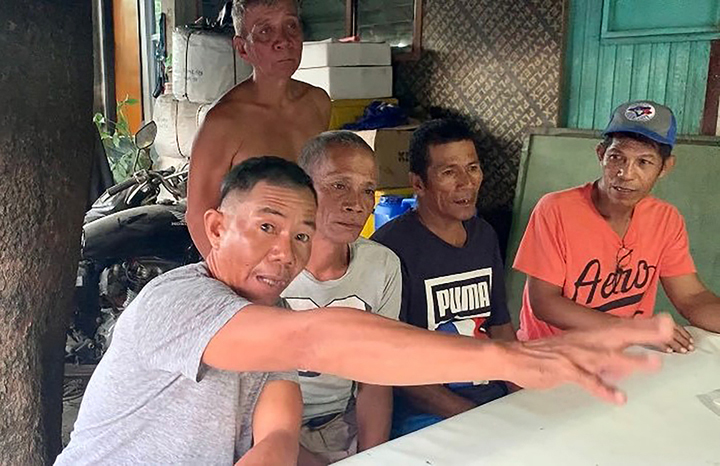
turn back, but they didn’t. Instead, they speeded up more.”
Danger zone
THE waters west of Zambales has always been a rich fishing ground for local fishers. Fishing, which is traditionally a major occupation of residents here, has brought Masinloc menfolk as far as 120 nautical miles away to the disputed Scarborough Shoal, which this municipality had formally claimed.
According to the town’s agriculture office, about 4,000 of the town’s roughly 48,000 residents are involved in fishing, with up to 800 fishing boats registered in the municipality each year.
However, tension at the Scarborough Shoal, also known locally as Bajo de Masinloc, had been high since the April 2012 standoff, making fishing in the disputed area dangerous. Fishers reported being barred and sometimes attacked by Chinese militia boats that blockaded the shoal. This curtailed fishing in the open sea among local fisherfolk, thus adversely affecting their livelihood.
In March 2013, a year after the Scarborough situation escalated, the Philippine government announced the nationwide deployment of payao devices to provide “more stable livelihood opportunities” for small fishermen operating within the country’s municipal waters.
Since fishes are known to congregate naturally around floating objects that may serve as feeding place or refuge from predators, the use of payao improved fishing efficiency with increased catch and reduced time and cost—mainly fuel—in searching for fish.
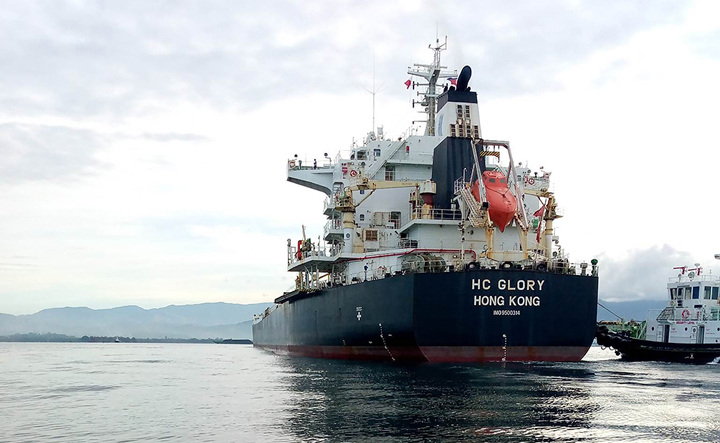
Masinloc port to deliver a load of coal.
The January 17 incident that destroyed a payao owned by Masinloc fishers, however, revealed another danger zone—dramatically defining another threat to the life and livelihood of small fishermen who fish in open waters.
And the ramming appeared to be intentional, the fishermen concluded in an interview with the BusinessMirror. “We signaled them to turn back, but they didn’t. Instead, they speeded up more,” they said.
Damage done
LEONARDO Cuaresma, president of the New Masinloc Fishermen’s Association (NMFA), the group that owned the destroyed payao, said he immediately filed an incident report with authorities as soon as some fishers arrived from sea to tell him about the disaster.
The culprit, he said in an incident report dated January 18 and addressed to the officer in charge of the Coast Guard Substation in Masinloc, was HC Glory, a bulk carrier operated by the Hong Kong Haichang Holdings Group Ltd.
The Hong Kong-flagged cargo ship was delivering coal to the Masinloc Coal-Fired Power Plant, and, as fishermen learned later on, it was just biding its time out in the open sea, awaiting its schedule to unload its cargo, when the disaster happened.
“This was not the first time that our payao was cut loose or destroyed,” Cuaresma lamented. Of the five payao that the NMFA has installed in the West Philippine Sea this year, he said, this was already the fourth to suffer a similarly sad fate.
“In the first three instances, there was no one around to see how the payao were destroyed. But this time, a lot of NMFA members saw with their own eyes what happened,” he said.
Cuaresma said the group estimated total damage at P900,000: P150,000 for the destroyed payao device; P360,000 in unrealized income from the scheduled payao harvest; and P390,000 for income from hook-and-line fishing by the 36 NMFA members that was lost when their payao was destroyed.
He added that aside from the economic losses the fishermen suffered, the ramming had endangered their lives. “If they were not able to untie their boats from the payao fast enough, they could have been hit by the ship, too,” Cuaresma pointed out.
The fisherfolk leader also stressed that they were keen on making the most out of their payao
project, which was funded through a P500,000 soft loan from the Office of the Vice President in April last year.
“We have put a lot of effort into this project, a lot of hope, since this provides a lot of opportunity for better income among local fishers, and not just members of our association,” Cuaresma said.
He said they have paid back just P120,000 of the seed money and had expected more income from the next harvest, only to be frustrated by this unfortunate turn of events.
Defensive maneuvers
After HC Glory docked in Masinloc on January 20 to unload its coal cargo, Cuaresma, with the assistance of the local Coast Guard and Philippine National Police Maritime Command, managed to get hold of the ship’s agent to discuss the matter.
A meeting between the two parties was set up, but when it came, Cuaresma was not allowed into the ship by officials from the Bureau of Customs.
In the meeting, the ship master issued a declaration that did not entirely belie the story of the fishermen, but nevertheless denied the damage done.
“We found a large number of fishing boats around our vessel at 1200H/17th/Jan/2023 at open seas about 8 miles distance of Masinloc port pilot station,” the ship master declared. “They waved their fish, asked if we wanted to buy their fish.”
“About 10 minutes later, we spotted a fishing boat heading toward the port front of our ship and motioned for us to back up. At the same time, we found a barrel floating near the fishing boat, which we judged to be a fishing float based on their hand signals. We set the ship back at once.”
“As there were also a large number of fishing boats astern of our vessel, we were worried that going backwards would cause a collision with other fishing boats. So, we stopped and sounded the whistle, and the fishing boat on our right gave way and we left the float from the right front. As we were about to cross the float, we stopped the main engine to avoid damaging the rope underneath.”
The ship captain’s statement went on to say that after leaving the area, the ship waited 0.2 nautical miles in front of the fishing boat for minutes. “When no fishing boat came, we sailed on for 2 nautical miles and continued to drift,” he added.
The statement went on to say that the payao was hardly noticeable to the ship. “The buoy is too small to be seen at night, too small to be scanned by radar, and to be seen very close even in daylight,” it said, adding that the fishing float “looks like an empty, discarded barrel.”
“Throughout, we did not find that we had damaged it, and we saw through our binoculars that the rope under the float had been under stress and judged it to be in good condition,” the ship master concluded.
David vs. Goliath
AS of now, the local fishermen are asking concerned government agencies for assistance in seeking settlement for the damages incurred, especially since HC Glory has since left port after completing delivery of its coal cargo in Masinloc.
“We really need help from the government so we could get some kind of settlement from the management of HC Glory,” Cuaresma said.
“This is difficult for us. We are contending with a giant,” he added.
The good news is that the fishermen won’t be alone in their fight. In a statement, the Zambales provincial government said it has taken up the cudgels for the local fishermen.
“We will definitely back up our people in their quest for justice,” said Governor Hermogenes Ebdane Jr. “I have already instructed our legal team to represent the fishermen, and the matter has also been referred to the agriculture and legal committees of the Sangguniang Panlalawigan to see what further assistance we can render,” he added.
Ebdane noted that aside from claims on destroyed property and income losses, the incident also highlighted the need for safety measures for local fishermen looking for livelihood in the open sea.
“There have been several reports of incidents like this, only undocumented. So, we have a lot to learn and assess and evaluate from this incident,” Ebdane said.
“The payao project in this case has also been funded by a government loan, so we are taking a special interest in this,” he added.
Image credits: Berenard Testa