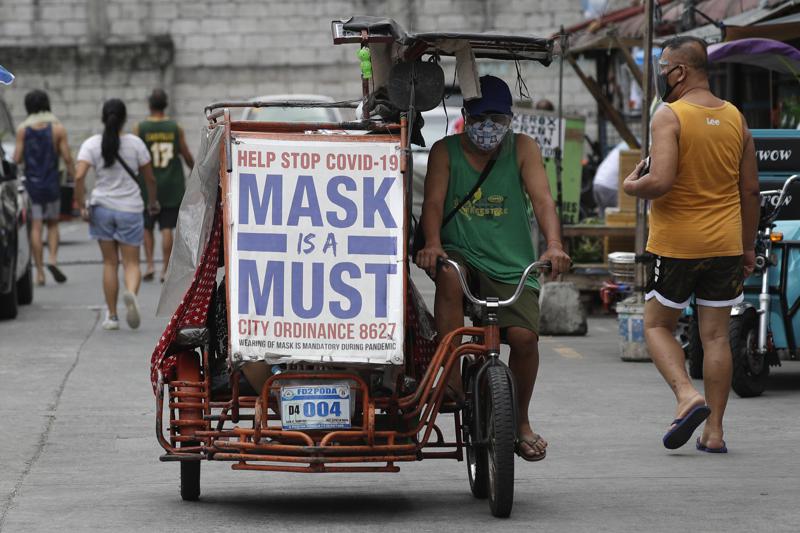

The Philippines has again logged a record-high of daily Covid-19 cases at 22,415, the highest daily number of infections recorded since the pandemic began. This brings the total number of cases in the country to 2,103,331.
The Department of Health (DOH) also recorded 20,109 recoveries and 103 deaths.
Of the total number of infections, 7.6 percent (159,633) are active, 90.8 percent (1,909,361) have recovered, and 1.63 percent (34,337) have died.
Sixty-eight duplicates were removed from the total case count. Of these, 53 are recoveries. Moreover, seven cases that were previously tagged as recoveries were reclassified as deaths after final validation.
All laboratories were operational on September 4, 2021, but 8 labs were not able to submit their data to the Covid-19 Document Repository System.
Based on data in the last 14 days, the 8 non-reporting labs contribute, on average, 2.3 percent of samples tested and 2.3 percent of positive individuals.
‘Slowing down’
DOH said that Metro Manila and some regions have shown a “slowing down” in the increase of Covid-19 cases, but national case classification and health systems capacity remain at high risk.
Health Undersecretary Maria Rosario Vergeire said majority or 95 percent of provinces, highly urbanized cities, and independent component cities remain flagged under Alert Level 3 and 4.
“More than half of the regions still with high-risk health capacity and majority or 82 percent of flagged areas have high-risk health capacity,” Vergeire said in an online media briefing.
She warned that cases may still continue to increase in the next weeks due to higher transmissibility of the Covid-19 Delta variant.
“And as we continue active case finding in areas, [we need to]: Implement strict granular lockdowns, shorten interval between detection and isolation, and enforcing minimum public health standards [MPHS] adherence to cut community transmission; Strengthen triage and referral systems and augment healthcare capacity to safeguard health capacity and; Ramp up priority vaccination to protect vulnerable population,” she said.
Top regions and areas with new cases
For September 5, 2021, the DOH said that the top regions of new cases are: National Capital Region (NCR)—5,102; Region 4A—4,430; Region 3—2,197; Region 1—1,413, and Region 7—1,061.
The top areas of new cases are: Cavite—1,521, Laguna—1,158, Rizal—841, Quezon City—829, and Bulacan—827.
As of September 5, the average daily reported cases: August 30-September 5: 18,292 August 23-29: 16,513 August 16-22: 14,349 August 9-15: 12,000. The previous peak was recorded on March 29-April 4: 10,431, while a new peak was seen every week since the second week of August.
Vergeire said “all areas at an uptrend, Luzon areas showing steep increase, and Visayas areas at a plateau.”
Eleven regions at high-risk case classification are; six regions with high-risk beds and ICU utilization; 3 other regions with high-risk ICU utilization.
NCR cases
NCR continues its upward trend with reported cases, increasing by 13 percent versus previous seven days.
The average daily reported cases: August 30-September 5: 4,974: August 23-29: 4,400: August 16-22: 3,883: August 9-15: 3,267. Cases peaked on March 29-April 4 at 5,536.
All areas in NCR have high-risk average daily attack rate, moderate to high-risk utilization rates for all districts; 16 areas with high-risk health systems capacity.
Deaths
Vergeire noted that deaths per day at 135 in April. The DOH is also closely monitoring Regions 3 after it recorded 56 deaths from September 1-5, NCR (26), Region 4A (24), Region 7 (22), Caraga (12), Region 12 (12), Region 1 (12), and Region 10 (10).
Proactive measures
Vergeire stressed that it is still expected that strict enforcement of MPHS especially in areas or activities included in 3C’s: closed, crowded, close contacts.
There is also a need to strengthen the active case finding and immediate isolation in granular lockdown areas; Ongoing augmentation of health system capacity and transfer of asymptomatic/mild cases to community facilities; Continuous monitoring of cases and healthcare utilization for adjustments in policy and response; Continuous implementation of border control restrictions and policies; Continuous coordination among national and local governments and; continuous provision of up-to-date information to the public.