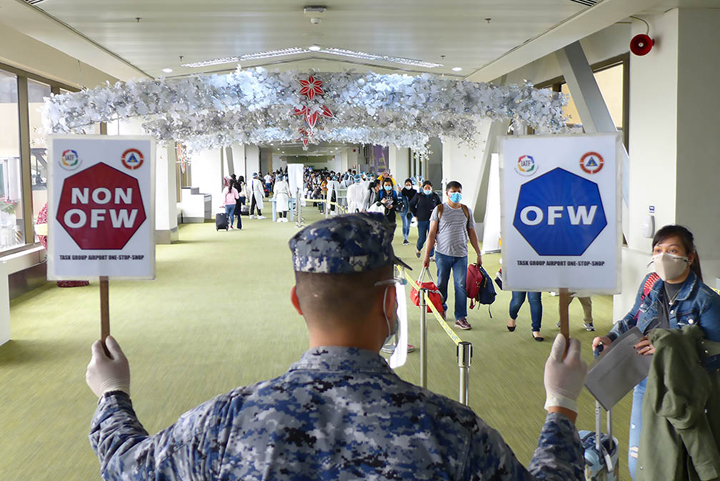
MAJORITY of overseas Filipino workers (OFWs) who returned to the Philippines because of the pandemic found themselves jobless three months after their arrival, according to a report by International Organization for Migration (IOM) Philippines.
In a presentation on Thursday, IOM Programmes Head Troy Dooley said some 83 percent of OFWs said they are still out of work three months after arrival. In 2020, IOM estimated that a total of 791,623 OFWs returned to the Philippines.
Further, there was a 75-percent decline in OFW deployment last year to only 549,841 Filipinos from 2.16 million in 2019. This constituted the lowest deployment number in over three decades.
“The jobless rate [was at] 83 percent of OFWs [who said] they’re unemployed three months post arrival on average. That’s a lot,” Dooley said on Thursday.
Income challenge
This is why 78 percent of those surveyed identified income generation as their primary challenge. In fact, based on the data, some 48 percent of them experienced a 60-percent decline in their incomes.
Further, Dooley said the report noted that some 17 percent did not receive their salaries before they returned to the Philippines.
At least 78 percent of OFWs who participated in the study said the primary challenge of OFWs when they returned was finding a job or some income-generating activity. The secondary challenge for 24 percent of respondents was repaying their debts.
Foreign Affairs Undersecretary Sarah Lou Y. Arriola admitted that this is a concern and that while there are agencies that are focused on reintegration, more work needs to be done.
“[This] tells us to work harder in the government to do more programs so that we will be able to accommodate returning Filipino workers so that they can be integrated in the Philippine domestic labor,” Arriola said. “The statistics show that we have to work harder in this part of the migration cycle.”
IOM data showed, Dooley said, some 45 percent of OFWs wanted to put up their own business. However, 69 percent did not have the capital to bankroll these ventures.
Over a third or 35 percent of OFWs who want to go into business want a business in service and sales, followed by the food industry at 27 percent and agriculture, forest and fisheries at 14 percent.
Ople: Many aspiring entrepreneurs
Blas F. Ople Policy Center and Training Institute President Susan Ople said that while the lack of capital is a problem, the data remains a story of hope because many OFWs want to become entrepreneurs.
Ople said the creation of an opportunity task force to help OFWs find the right opportunities, especially when they come home, might be worth studying.
“Those who have returned are still thinking and planning about their future. We just need to tell them ‘you know this will pass and you have to prepare yourself you have to prepare your families. These are hard times but we’ve all gone through hard times. Generation upon generation went through hard times,’” she explained.
Unregistered with portal
Meanwhile, Institute for Migration and Development Issues Executive Director Jeremaiah Opiniano cited another interesting data from the IOM report: nearly half, or 46 percent of OFWs did not register or access reintegration assistance from the government.
Opiniano said this was difficult to understand given that arriving OFWs can easily register with the OFW Assistance Information System (OASIS). This is an online platform that aims to facilitate the return of OFWs.
The data shared by Dooley also showed that 47 percent of those who did not register with the OASIS are land-based OFWs and 43 percent were sea-based workers. The data showed the assistance preferred by 75 percent of OFWs was cash, while 14 percent said they preferred livelihood assistance.
“The Philippines being a global model on managing migration among countries of origin showed during the pandemic.
The government and partners are helping repatriated migrant workers on a best-effort basis, to the ability that civil servants’ human strengths and powers can go further,” Opiniano, however, said.
Based on data presented by Dooley, three months after their return, some 48 percent of the respondents planned to remigrate abroad while 35 percent preferred to stay home.
Around 15 percent of them remained undecided on what they will do next while 2 percent wanted to migrate internally.
IOM said the report, based on interviews with over 8,000 returned OFWs, aims to better understand the challenges, as well as the needs of migrant workers.
“The ongoing global Covid-19 crisis and border restrictions continue to have an adverse impact on human mobility with migrant workers and their remittance-dependent communities being some of the most vulnerable groups,” said Kristin Dadey, IOM Philippines Chief of Mission.
“Understanding the impacts of Covid-19 on OFWs and their families is critical to identify emerging gaps in migration governance and international cooperation adhering to the Global Compact for Safe, Orderly and Regular Migration. Findings of the report could support key stakeholders in developing migrant-centered policies and programs with the most recent and relevant information,” continued Dadey.
As Coordinator and Secretariat of the United Nations Network on Migration in the Philippines, IOM has conducted various studies on the impact of Covid-19 on migration to support policy-makers and has provided direct assistance to the government’s repatriation efforts.
The report seeks to further complement this initiative by informing future programs on international recruitment, migrant worker protection in times of crises, and reintegration of returned OFWs. Collected data is also used to map out returning OFW mobility flows and identify sociodemographic patterns of migration and needs, preferences, skills and experiences of returned OFWs.
“Covid-19 pandemic has presented new challenges for OFWs and highlighted their existing vulnerabilities. There is a particular need to leverage data and analysis collected into policies that will fill existing gaps in migrants’ welfare and safety,” said Gustavo Gonzalez, the UN’s Resident Coordinator and Chair of the UN Network on Migration in the Philippines, echoing the significance of the report.
Hans Cacdac, Overseas Workers Welfare Administration (OWWA) administrator, expressed his appreciation to IOM and the UN Network on Migration in the Philippines for its efforts; and said the report is useful especially in responding to unforeseen crises such as the Covid-19 pandemic.
“The Covid-19 Impact Assessment on Returned Overseas Filipino Workers will be a key tool in the government’s formulation of future policies and programs for OFWs,” he said.
The assessment and report were supported with funding from the Government of the Federal Republic of Germany and produced in partnership with the OWWA.