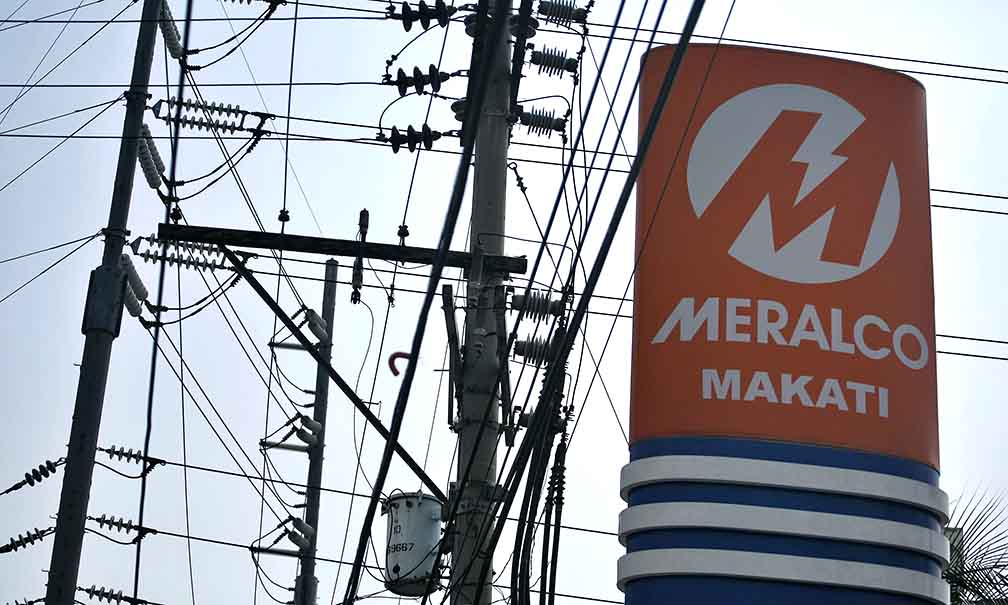
Electricity rates for the month are up by P0.1853 per kilowatt-hour (kWh), from last month’s P8.4067 to P8.5920 per kWh, mainly due to the completion of the refund of over-recovery in pass-through charges.
The Manila Electric Company (Meralco) said Friday that the slight upward adjustment is equivalent to an increase of around P37 in the total bill of a residential customer consuming 200 kWh. This month’s overall rate is still lower than last year’s rate by P0.1548 per kWh.
Meralco said this month’s rate increase was tempered as it continues the implementation of the Distribution Rate True-Up refund that began in March this year.
It can be recalled that the Energy Regulatory Commission (ERC) provisionally approved Meralco’s proposal to refund around P13.9 billion over a period of 24 months or until the amount is fully refunded.
This amount represents the difference between the Actual Weighted Average Tariff and the ERC-approved Interim Average Rate for distribution-related charges for the period July 2015 to November 2020. For residential customers, the refund rate is P0.2761 per kWh and appears in customer bills as a line item called “Dist True-Up.”
With the completion of the ERC-approved refund of over-recoveries in pass-through charges, the corresponding deduction for the refund will no longer appear beginning with the May bill. The ERC directed Meralco to refund over-recoveries in transmission and other charges. Meralco implemented the ERC-approved adjustments starting January 2021 and completed the refund of over-recoveries last April. The impact to residential customers, from the months of January to April 2021, was a refund of around P0.15 per kWh.
Generation charge for May is stable at P4.5474 per kWh, a slight P0.0104 per kWh increase from last month’s P4.5370 per kWh.
Charges from the Power Supply Agreements (PSAs) increased by P0.2541 per kWh due to low dispatch of San Gabriel as a result of the ongoing restriction of Malampaya natural gas supply.
Wholesale Electricity Spot Market (WESM) charges also remained high due to tight supply conditions in the Luzon grid as capacity on outage stayed above 3,300 MW and Luzon peak demand in April still exceeded 10,400 MW. However, these were offset by lower charges from the Independent Power Producers (IPPs), which decreased by P0.1921 per kWh.
PSAs provided 52 percent of Meralco’s energy requirement while WESM share was down to 7 percent this month. IPPs share this month was 41 percent.
Transmission charge for residential customers increased by P0.0933 per kWh due to completion of transmission refund coupled with higher ancillary service charges. Taxes and other charges also registered a net increase of P0.0816 per kWh.
Meanwhile, collection of the Universal Charge-Environmental Charge amounting to P0.0025 per kWh remains suspended, as directed by the ERC.
Meralco’s distribution, supply, and metering charges, meanwhile, have remained unchanged for 70 months, after these registered reductions in July 2015.
Payment for the generation charge goes to the power suppliers, while payment for the transmission charge goes to the National Grid Corp. of the Philippines (NGCP). Taxes and other public policy charges like the Universal Charges and the FiT-All are remitted to the government.
Meralco reiterated its call for energy efficiency, as historically, the summer season may bring an increase in residential electricity consumption by 10 percent to 40 percent versus average consumption during the cool months of January and February.
As temperature increases, appliances that have compressors, like air-conditioners or refrigerators, will have to work harder. Electric fans are also used longer than usual, and often at “high” setting to beat the summer heat.
According to Meralco First Vice President and Chief Commercial Officer Ferdinand O. Geluz, “This summer, you have the power, as Meralco encourages its customers to continue practicing energy efficiency initiatives at home to be ready in managing their consumption.”
Geluz added “these simple everyday activities include cleaning your air-con filters every two weeks to ensure optimal performance, setting your air-con’s thermostat to 25oC to maximize efficiency, making sure you use the right air-con size for your room, making sure your refrigerator’s air vents are not blocked to keep its compressor from working harder, unplugging appliances when not in use to avoid phantom load, using a power strip to make it easier and more convenient to turn appliances off simultaneously with just one switch, and maximizing natural light during daytime.”
Last May 5, the NGCP placed the Luzon grid on yellow alert due to insufficient operating reserve brought about by high system demand, forced outage and deration of generating power plants.
The power plants that went on forced outage are Sual 2 (647 MW), Calaca 2 (300 MW), GNPower 1 (316 MW), GN Power 2 (316 MW), Malaya 2 (130 MW), SLPGC 1(150 MW), SLPGC 2 (150 MW), SLPGC 3(25 MW) and SLTEC 2 (123 MW). In all, these plants failed to deliver 2,157 megawatts (MW).
De-rated Plants: Masinloc 1 at 305 MW(315 MW) and Masinloc 2 at 310 MW(344 MW) (Total deration= 44 MW). While Ilijan CCPP was limited to 767 MW(1200 MW) due to SPEX Malampaya Gas supply restriction.
The Sual 2 (647 MW) remains out, same with GN Power 1&2 (316 MW each), SLPGC 1&2 (150 MW each) and Magat 1&2&3&4 (95 MW each). Ilijan’s output is still reduced by 433 MW due to the ongoing SPEX gas supply restriction.
A yellow alert is raised when a power grid’s power reserve, the difference between supply and demand, is below the required level, according to NGCP.
The NGCP recently conducted a virtual blackout simulation drill to test the grid’s reliability in the event of a major power disturbance.
The presentations for the area and regional control centers for Luzon, Visayas, and Mindanao were done via videoconferencing and the actual blackout simulation drills were conducted a week after the virtual meetings.
“By discussing our plans and procedures with key industry players, we will be able to improve the resiliency of the grid and ensure the continuous and unhampered transmission of power in the new normal,” stated NGCP.
The grid operator could not stress enough the importance of the annual exercise, particularly at this time of the year when demand is at its peak and a number of power plants are still on prolonged outage. “We need to be constantly prepared for any and all challenges the grid may face. The stability of the country’s power transmission rests on the expertise of our team, and our ability to navigate through critical incidents.”
Workshops included blackout scenarios occurring in different areas of the country, power system blackout restoration guidelines, and the power restoration highways. This ensures that in case of any major power disturbance or blackout due to any calamity or emergency, NGCP’s regional and area control centers, as well as the power generators, know their specific roles in restoring power in their area of responsibility.