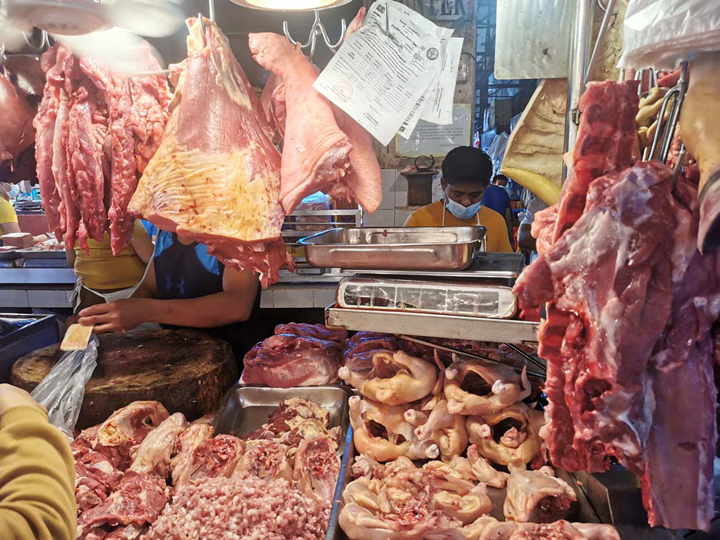

The Philippines has approved the importation of 1.717 million metric tons (MMT) of meat products as of end-August—more than double than last year’s volume—driven by the country’s dire need for pork supply.
The volume was based on the total number of sanitary and phytosanitary import clearances (SPS-ICs) approved and issued by the Bureau of Animal Industry (BAI) for meat imports from January to August.
The volume, based on latest BAI data, was 107 percent higher than the 828,892.915 MT approved for importation in the same period of last year.
BAI data showed that pork imports accounted for half of the approved SPS-ICs during the eight-month period or about 837,955.337 MT, which was triple from the 276,424.228 MT approved volume in the January-to-August period of last year.
Chicken meat imports accounted for 35 percent of the total SPS-ICs for meat products as traders and importers were allowed to import 599,860.987 MT of chicken meat, which was 67 percent higher than last year’s 359,861.712 MT.
The BAI, an attached agency of the Department of Agriculture (DA), also approved the importation of 237,164.714 MT of beef products, which was 48 percent more than the 159,945.948 MT it approved last year.
Industry sources told the BusinessMirror that the increase in approved SPS-IC reflects the country’s need for meat products, particularly for pork as the country grapples with a shortfall due to the devastation of African swine fever (ASF) to domestic hog farms.
The government earlier lowered pork tariffs and increased the minimum access volume (MAV) for the commodity by 200,000 MT in a bid to boost domestic supply and pull-down sky-rocketing pork prices.
Only half arrived
However, BAI data showed that total meat imports arrival during the January-to-August period was only half than what the agency approved or about 800,152.239 MT.
Nonetheless, total meat import arrival was 45 percent higher than the 552,590.826 MT volume recorded in the eight-month period of last year, based on BAI data.
BAI data showed that pork imports alone almost tripled to 389,556.863 MT from last year’s 137,131.271 MT, while chicken meat imports declined slightly to 260,881.849 MT from 267,937.066 MT.
The BusinessMirror earlier reported that the National Economic and Development Authority (Neda) urged the Department of Agriculture (DA) to fast-track the issuance of the necessary importation documents to avert food supply problems during the holiday season.
Neda Undersecretary for Regional Development Mercedita A. Sombilla told the BusinessMirror that this would allow the Philippines to boost its food stocks amid the global logistics crisis.
“We just have to push the DA to issue SPS-IC [sanitary and phytosanitary import clearance and] CNI [certificates of necessity to import] early so traders can have shipments early. We already informed the DA [regarding] that problem,” Sombilla said.
Last month, the DA heeded the call of importers to extend the validity of SPS-IC for imported meat to ensure the much-needed supply would arrive in the country in time for the holidays.
The DA issued Administrative Order (AO) 21 that authorized the temporary extension of SPS-IC validity by 30 days from 60 days to 90 days.
The BusinessMirror first broke the story that industry stakeholders have proposed to Dar the extension of the SPS-IC validity to avert additional costs in the retail price of certain food items.