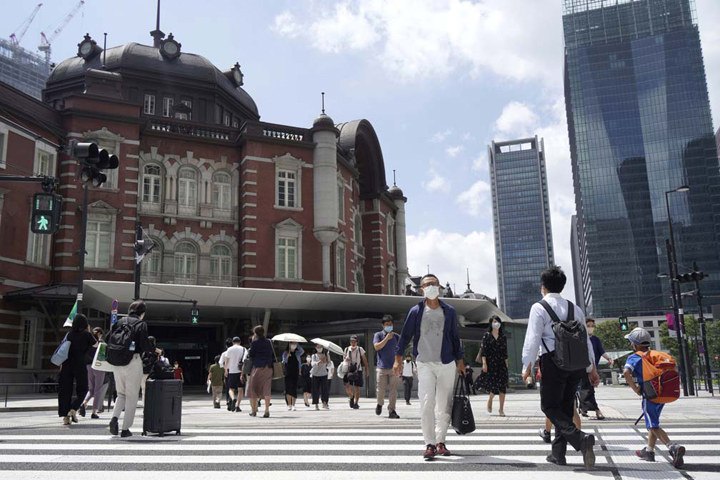

TOKYO—Japan was set to expand its coronavirus state of emergency for a second week in a row on Wednesday, adding several more prefectures as a surge in infections fueled by the Delta variant strains the country’s health-care system.
The government last week extended the state of emergency until Sept. 12 and expanded the areas covered to 13 prefectures from six including Tokyo. Sixteen other prefectures are currently under quasi-emergency status.
The government at a meeting of experts Wednesday proposed upgrading eight prefectures from quasi-emergency status to a full state of emergency. Those prefectures include Hokkaido and Miyagi in the north, Aichi and Gifu in central Japan, and Hiroshima and Okayama in the west.
The proposal was expected to be approved and formally announced later Wednesday.
Japan’s state of emergency relies on requirements for eateries to close at 8 p.m. and not serve alcohol, but the measures are increasingly defied. Unenforceable social distancing and tele-working requests for the public and their employers are also largely ignored due to growing complacency.
The Japanese capital has been under the emergency since July 12, but new daily cases have increased more than tenfold since then to about 5,000 in Tokyo and 25,000 nationwide. Hospital beds are quickly filling and many people must now recover at home, including some who require supplemental oxygen.
More than 35,000 patients in Tokyo are recovering at home, about one-third of them unable to find a hospital or hotel vacancies immediately. Only a small percentage of hospitals are taking virus patients, either for financial reasons or because they lack the capability to treat the infections, experts say.
Japan has weathered the pandemic better than many other countries, with around 15,600 deaths nationwide since the start, but its vaccination efforts lag behind other wealthy nations. About 40 percent of the population has been fully vaccinated, mainly elderly people.
Economy and Fiscal Policy Minister Yasutoshi Nishimura, also in charge of the Covid-19 measures, said Wednesday that infections are spreading among those in their 20s to 50s who are largely unvaccinated. He urged them to take extra caution.
“Just imagine you may be the one getting infected tomorrow,” he said.
Rising infections among schoolchildren and teenagers could accelerate the surge as they begin returning to school after the summer vacation, said Dr. Shigeru Omi, top government medical advisor. He proposed schools curtail activity and urged high schools and colleges to return to online classes.
“Infections in Tokyo are showing no signs of slowing, and the severely tight medical systems will continue for a while,” he told a parliamentary session Wednesday.
The government has faced criticism for holding this summer’s Tokyo Olympics and Paralympics despite strong opposition from the public. Officials deny any direct link between the games and the spike in infections.
Other developments:
S. Korea reports 2,155 new cases
South Korea has reported 2,155 new coronavirus cases, nearly matching a record daily increase set earlier this month amid an alarming spread of infections.
With Wednesday’s report, the country has tallied more than 1,000 new cases for 50 consecutive days, including a record 2,221 on August 11.
The virus has shown no signs of slowing despite officials enforcing strong social distancing restrictions short of a lockdown in Seoul and other large population centers where private social gatherings are banned after 6 p.m.
The Health Ministry is concerned that transmissions could further increase during next month’s Chuseok holidays, the Korean version of Thanksgiving when millions of people travel across the country to meet relatives. It is considering measures to reduce travel during the period, such as limiting train occupancy.
New daily high for New South Wales
Australia’s New South Wales state has recorded another new daily high of 919 coronavirus infections. It also has had two more deaths related to Covid-19.
New South Wales’s previous high for a 24-hour period was 830 infections reported Sunday.
Health Minister Brad Hazzard said Wednesday that the health system in Australia’s most populous state is under pressure but is coping.
The Covid-19 death toll has reached 76 in New South Wales since the outbreak of the Delta variant was first detected in Sydney on June 16.
Neighboring Victoria, Australia’s second-most populous state, reported 45 new infections Wednesday.
Both states are locked down.
Idaho hospitals swamped
State leaders in Idaho are urging people to volunteer at hospitals to help health workers who are being swamped by a rising number of Covid-19 cases.
Idaho Public Health Administrator Elke Shaw-Tulloch says hospitals need help with everything from housekeeping to delivering care, which could be provided by retired health workers.
The director of the Idaho Department of Health and Welfare says volunteer help is badly needed to keep the state’s medical facilities operating.
Dave Jeppesen says that “their level of capacity is so strained that we are talking about crisis standards of care—we’re dangerously close to that as this point in time.”
As of Friday, the number of coronavirus infections statewide had increased 31 percent compared to the previous week, and hospital admissions for Covid-19 were up about 30 percent, according to data from the CDC.
Ivermectin poisoning in Alabama
A poison control hotline in Alabama is fielding increasing calls about possible poisoning with Ivermectin poisoning, an animal de-wormer that doctors are warning people not to try as a home remedy for Covid-19.
The Alabama Poison Information Center at Children’s of Alabama has fielded 24 Ivermectin exposure cases so far this year, of which 15 were related to Covid-19 prevention and treatment. It says there have been five other calls seeking information about Ivermectin.
By comparison, the center had six total calls involving the de-wormer in 2019 and 12 in 2020.
Federal regulators have approved Ivermectin to treat people and animals for some parasitic worms and for head lice and skin conditions, but the drug is not approved for Covid-19. The human and animal formulations are not the same, and doctors say it is dangerous for people to self-dose, particularly with the large quantities given to animals.
Fauci pushes antibody treatments
Dr. Anthony Fauci is urging hospitals and doctors to make greater use of antibody treatments for people infected with Covid-19 as hospitalizations and deaths rise due to the spread of the Delta variant.
Infusions of antibody drugs can keep patients who are experiencing mild-to-moderate symptoms from getting so sick they need hospitalization, the government’s top infectious disease specialist said at Tuesday’s White House coronavirus briefing. They also can serve as a preventive treatment for people exposed to someone with a documented infection.
Three antibody products are available under emergency use authorization from the Food and Drug Administration, and they’re free thanks to taxpayer support. But Fauci says they remain “a much-underutilized intervention.”
However, demand for the drugs increased five-fold last month to nearly 110,000 doses, with the majority going to states with low vaccination rates. Texas Republican Gov. Greg Abbott has been among the patients treated with antibodies. AP
Image courtesy of AP/Kantaro Komiya