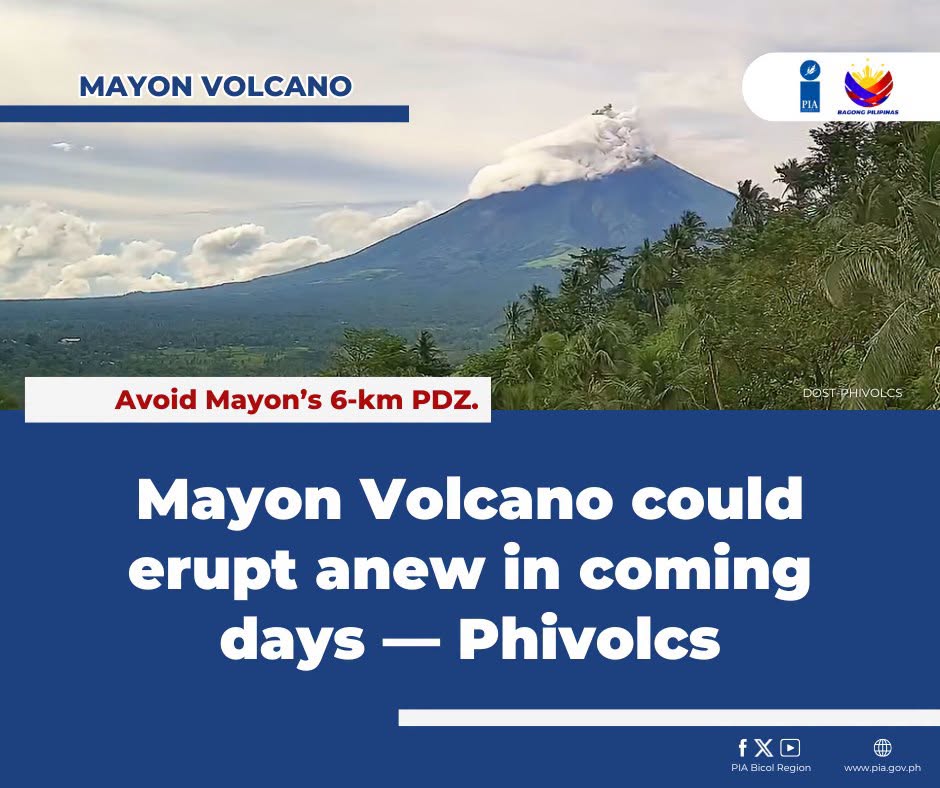
LEGAZPI CITY (PIA) — There is a possibility that eruption could recur in the country’s most active volcano in the coming days, state volcanologists said Tuesday.
“(That’s why) the public must refrain from entering the 6-kilometer-radius Permanent Danger Zone (PDZ), a prohibited area around the Mayon Volcano in Albay”, the Philippine Institute of Volcanology and Seismology (Phivolcs) said in an advisory.
Communities and local government units near the area should prepare for possible emergencies and be ready to act if the situation worsens and the alert level rises to Alert Level 3, the agency added.
The Phivolcs on Monday recorded a sharp increase in sulfur dioxide (SO2) emissions at the volcano.
In the advisory, Phivolcs said the volcanic SO2 flux on August 17 reached 8,393 tonnes in the past 24 hours, the highest emission from Mayon recorded since SO2 gas emission began decreasing on July 16.
The agency said the SO2 flux from the day the volcano’s status was lowered to Alert Level 2 on August 5 until August 16 averaged only 2,532 tonnes per day.
On August 12, Phivolcs alerted nearby residents to remain vigilant after an ash plume was briefly emitted at 6:03 p.m. and blown to the northeast.
According to Phivolcs, yesterday’s abrupt increase in emissions from Mt. Mayon, which has had effusive and strombolian eruptions from January to July that led to the evacuation of thousands of residents, was linked to swelling on the northern and eastern sides of the volcano.
The volcano remains under alert level 2, or moderate level of unrest.
“Nonetheless, elevated volcanic SO2 emissions could forewarn of a potential shift to renewed eruptive activity at the summit crater,” Phivolcs warned.
It could lead to dangerous situations in areas near the volcano, especially given the current unfavorable weather conditions, Phivolcs added.
Phivolcs said an intensified unrest could generate life-threatening volcanic hazards, including fast-moving hot gas and ash clouds, falling rocks, and pieces of the volcano being blasted into the air.
There may also be heavy ashfall, which can greatly affect nearby communities, it added.
Like in past advisories, Phivolcs on Monday urged the public to stay alert and take preventive measures to protect against lahars (mudflows) and sediment-heavy water along the river channels near the volcano, especially during heavy rains.
This is especially crucial if there is also a risk of an explosive eruption, it added.
Pilots were advised to avoid flying close to the volcano’s summit. Source: PIA Bicol