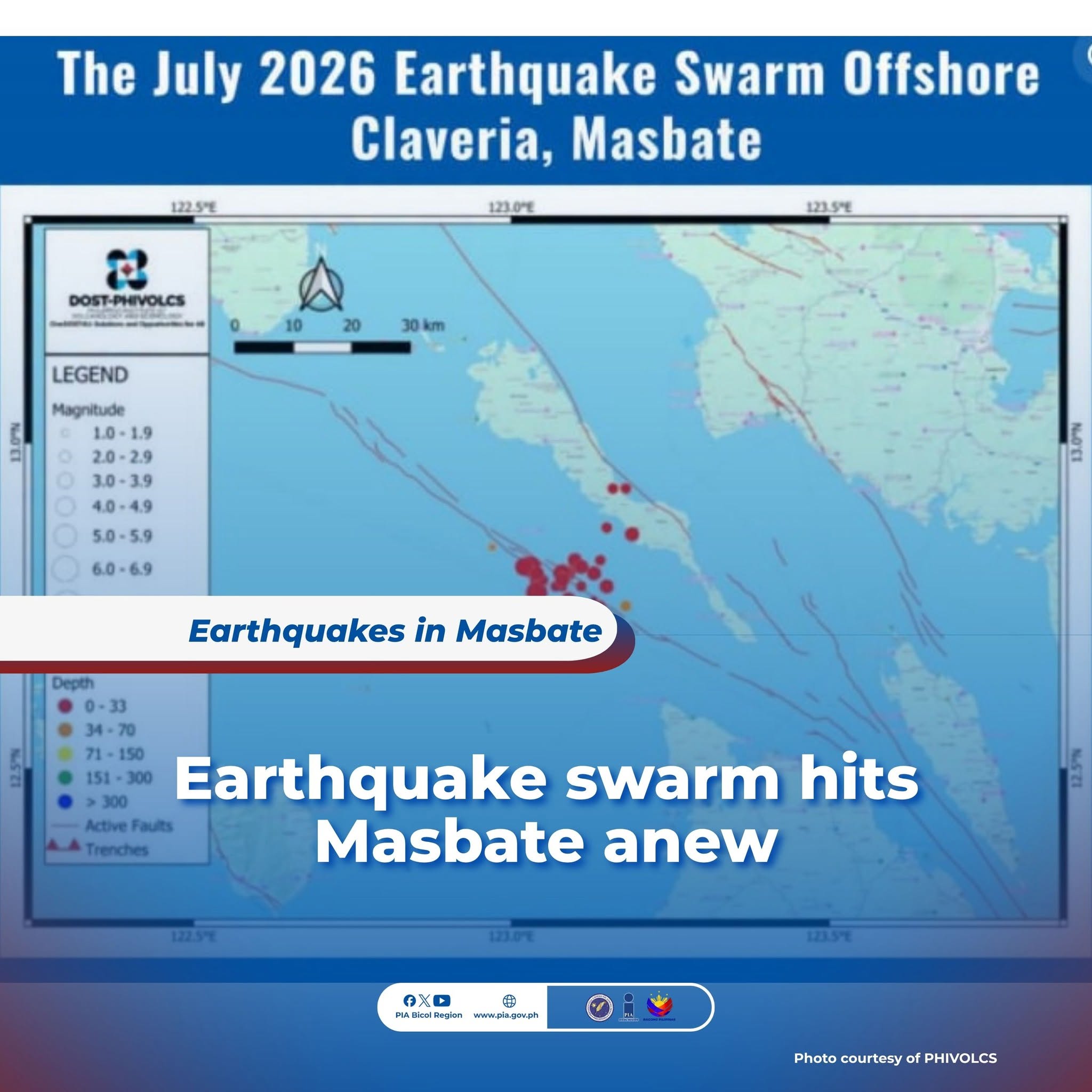
Over 100 earthquakes, including a magnitude-5.4 tremor recorded on Monday last week, occurred off Claveria, Masbate, about 500 kilometers south of Manila, causing damage to buildings.
The seismic activity has been centered in Claveria, one of the two towns on Burias Island.
The three strongest earthquakes in this sequence took place on July 13 at 9:22 a.m. (magnitude 5.4), on July 14 at 1:30 p.m. (magnitude 4.7), and on July 21 at 9:48 p.m. (magnitude 4.2).
Between July 13 and July 14 alone, 54 earthquakes were documented, with details regarding their locations, magnitudes, depths, and fault types represented on maps.
According to the Philippine Institute of Volcanology and Seismology (Phivolcs), at least five offshore earthquakes were felt at Intensity V on the Phivolcs earthquake intensity scale, affecting Burias Island and surrounding provinces.
The magnitudes of these earthquakes ranged from 1.6 to 5.4, and their depths varied from 1 kilometer to 45 kilometers.
The municipal government of Claveria reported damage to infrastructure following the series of earthquakes.
Cracks were observed in the walls, beams, and floors of both Curvada Elementary School and Nonoc Elementary School. As a result, two classrooms in each school have been declared unsafe for occupancy.
Mayor Karen Ballesteros closed both public and private schools for inspections until she announced the resumption of in-person classes, set for July 20.
“An earthquake swarm is a series of earthquakes occurring in the same area over a short period, but without a distinct mainshock followed by aftershocks,” said Ronald dela Cruz, the officer in charge of the Phivolcs station in Masbate.
“It can last for several days, weeks, or even longer,” he added.
Some people are concerned that the swarm of seismic activity could trigger a stronger and more damaging earthquake.
“It is possible, but it’s also possible that it won’t happen. Therefore, it is important to remain vigilant and always be prepared,” Phivolcs explained in a primer it shared on Facebook.
Seismologists explained the reasons behind the lingering seismic swarm in the offshore area near Claveria.
Masbate is located along the Philippine Fault Zone, which is one of the country’s most active fault systems, according to Phivolcs.
That location makes the area particularly vulnerable to recurring seismic activity.
In late December, the same area experienced an earthquake swarm.
Ongoing monitoring, preparedness, and following official advisories are the best responses as scientists observe any changes in seismic activity.
Source: PIA Region 5/E Delgado