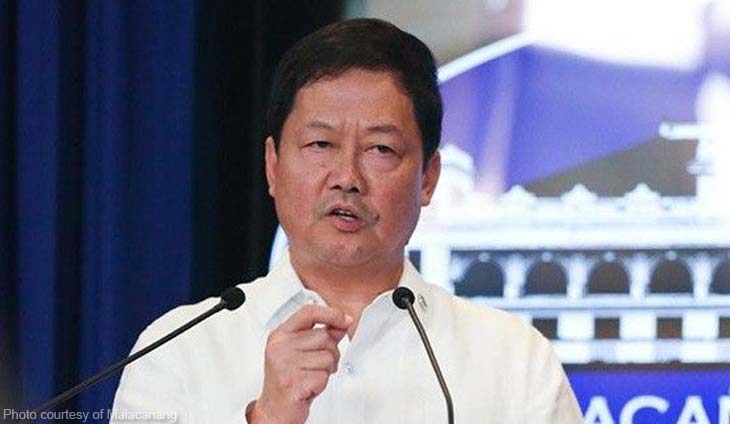
JUSTICE Secretary Menardo Guevarra on Wednesday assured that the Commission on Human Rights (CHR) would not be left out in the ongoing efforts of the Department of Justice and the Philippine National Police (PNP) to end extrajudicial killings and other human-rights abuses reportedly being committed by rogue law enforcers in the implementation of the government’s anti-illegal drugs war.
However, Guevarra is non-committal on suggestions that the CHR should also be given access to the 61 cases that the DOJ-led inter-agency review panel would soon look into.
“This matter will be for further discussion, the DOJ has its own separate agreement with the CHR. Besides, the CHR’s involvement may be in some other form, such as in locating and assisting witnesses. This was one of the things that I discussed with CHR today as I intend to honor the DOJ’s commitment to engage the CHR in this endeavor,” Guevarra told reporters.
Guevarra’s statement came after PNP Chief Guillermo Eleazar agreed to give the DOJ Panel access to review its records involving anti-illegal drugs operations where deaths occurred.
Eleazar’s cooperation, according to Guevarra, was prompted by the former’s desire to discipline wrongdoers among the ranks of the policy and uplift the image of the PNP as protectors of the people.
The DOJ said it would focus on 61 cases involving hundreds of PNP personnel nationwide where the PNP-Internal Affairs Service had already found either administrative or criminal liability on the part of law-enforcement officers.
However, Eleazer said in an interview with ANC that he is willing to give the DOJ access to records of all its investigations against policemen in its drug war campaign since 2016.
In response, Guevarra said: “The 61 cases where liability was established by the PNP IAS came from the more than 6,000 cases reviewed by the IAS. We thus presume that the rest were dismissed. If the PNP chief has said that the review panel may also review these other cases, we will be very happy to do so, as this is what we have wanted in the first place.”
Meanwhile, DOJ Undersecretary Adrian Ferdinand Sugay said that they are now finalizing the terms in the memorandum of agreement with the PNP with regard to the review of cases where alleged EJKs happened.
“We are currently working on the memorandum of agreement as per the instructions of DOJ Secretary Guevarra. We hope to finalize this document in the next few days,” Sugay said.
On June 30 last year, Guevarra informed the United Nations Human Rights Council (UNHRC) of the existence of a panel reviewing 5,655 anti-illegal drugs operations where there had been reported casualties.
The panel’s task was to re-evaluate these anti-illegal drugs operations and, if necessary, file appropriate charges against erring law-enforcement officers.
They also intended to discuss with the affected families and provide them with legal options and assistance on the criminal prosecution of law enforcers who may have overstepped legal boundaries in their operations.
Last January, the DOJ chief submitted their initial report on the review to President Duterte.
Meanwhile, National Union of Peoples’ Lawyers (NUPL) President Edre Olalia questioned why would the DOJ only have access to 61 cases when the Justice Secretary said there were 5,655 anti-illegal drug operations where there had been reported casualties.
“That only 61 cases are currently seen with ‘clear liability’ out of the thousands of cases that are supposedly within the purview of the drug war panel review is simply incredible and scanty when seen in the context of the records, experience and reality over time,” Olalia said.