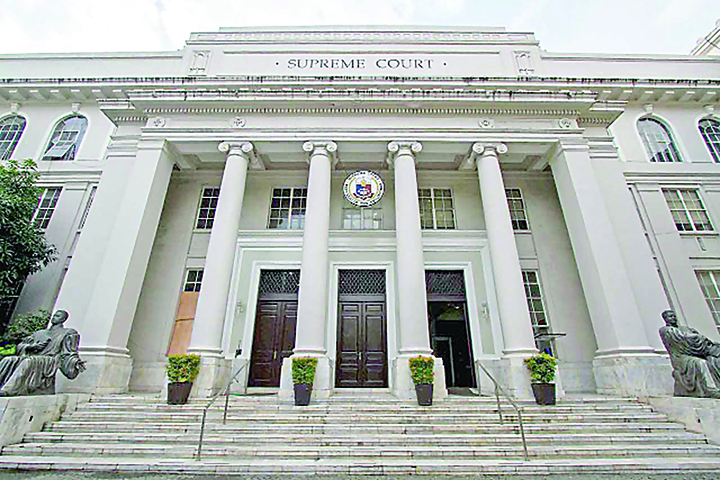
SEVERAL activist groups urged the Supreme Court (SC) on Tuesday to draw up new measures that would shield people, particularly human rights advocates, against red-tagging and other abuses of the law.
In a nine-page letter sent to SC Chief Justice Alexander Gesmundo, the groups sought judicial safeguards as they submitted case summaries, which, they said, highlighted the ongoing human rights violations under the Duterte regime.
They alleged that the government’s counter-insurgency campaign is the primary moving force in the commission of gross human rights violations such as arbitrary arrests and extrajudicial killings.
They sent the letter amid continuing allegations of red-tagging and the Anti-Terrorism Council’s (ATC) listing of 29 people as suspected members of the Communist Party of the Philippines and affiliated with local terrorist groups.
They also took note of the report of the National Union of People’s Lawyers (NUPL) to the SC last April 23 that stated 84 of the 147 attacks on lawyers and judges or 57 percent, during the past 10 years, were committed against lawyers who were engaged in human rights and public interest litigation.
The groups are specifically asking the Court a review of existing rules on the writ of amparo, the writ of habeas data, the writ of habeas corpus, and other predetention and pretrial remedies in order to determine whether these measures are still efficient in safeguarding fundamental rights.
They added that an assessment should also be conducted on how courts have appreciated and ruled upon in amparo and habeas data proceedings, the discharge of the burden of proof by petitioners as well as compliance with the required standard of diligence by respondents.
The Court was also urged to consider the inclusion of groups or associations of persons sharing a common advocacy or cause as aggrieved parties who may file a petition for the writ of amparo or habeas data.
The groups are also pushing for the mandatory issuance of a Temporary Protection Order (TPO) simultaneously with the issuance of the writ of amparo to be served on the respondents together with the writ, which may include an injunction on acts of red-tagging, both online and offline.
They also urged the Court to abandon its rule established in Ilagan v. Enrile case that declares moot and academic a habeas corpus petition of a person deprived of liberty with the filing of criminal charges against her or him by law enforcement authorities.
Other requests from the groups include the promulgation of rules that will ensure the proper and timely receipt of subpoenas and criminal complaints by respondents; establishment of a central repository of criminal charges by which the people can be informed of cases filed against them; the promulgation of uniform rules for pre-trial remedies that uphold the accused’s constitutional right to due process; requiring the active presence of independent witnesses during implementation of search warrant to ensure strict compliance with constitutional requirements and due regard for constitutional rights; inventory and investigation of serially issued search warrants by alleged “search warrant factories; and issuance of new rules that are more responsive in providing urgent and practical reliefs for victims of rights violations.
Among the groups who sent the letter to the SC include officials from the Bagong Alyansang Makabayan, Kilusang Mayo Uno, and the Alliance of Concerned Teachers.