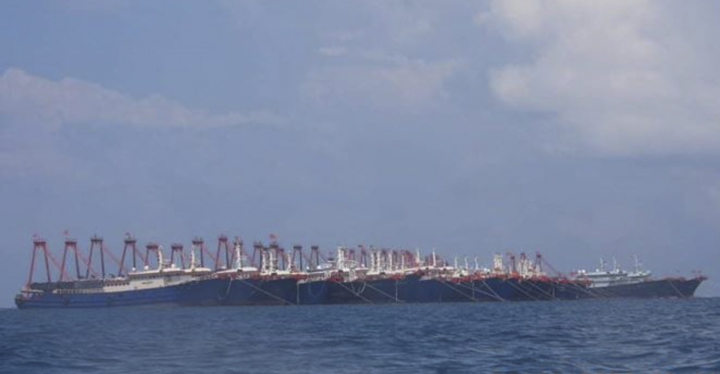
FOREIGN diplomats on Wednesday expressed alarm over the tense situation in the West Philippine Sea, as Manila has called out Beijing anew over the swarm of more than 200 suspected militia vessels at Julian Felipe Reef. The foreign envoys fear it could escalate into an armed confrontation, and urged both parties to settle their disputes through peaceful means.
This, as Foreign Affairs Secretary Teodoro L. Locsin Jr. asserted that the Philippines will not walk away from any similar face-off such as what happened in the Scarborough Shoal in 2012, a debacle he had blamed on bungled brokering by the United States between Manila and Beijing.
Nigel Adams, who served as UK Minister of State for Asia since 2020 said in a tweet, “The Philippines is an important partner for the UK in the Indo-Pacific. I spoke to Secretary of Foreign Affairs Teddyboy Locsin about our integrated review and our shared concerns on Myanmar and the South China Sea, including actions which raise tensions there.”
Australian Ambassador to the Philippines, Steven J. Robinson, for his part, expressed support on Twitter for keeping the status quo in the Indo-Pacific region, “which is secure and open and inclusive.”
“The South China Sea—a crucial international waterway—governed by international rules and norms, particularly UNCLOS. We remain concerned about destabilizing actions that could provoke escalation,” he said in a tweet.
Japanese Ambassador to the Philippines Kazuhiko Koshikawa, also on Twitter, said, “The South China Sea issues are directly related to peace and stability and concern for all.
Japan strongly opposes any action that heightens tensions. We support the enforcement of Rule of Law in the sea and work with the international community to protect the free, open, and peaceful seas.”
Chinese embassy
THE Chinese Embassy in Manila issued a statement, saying, “China as a littoral state of the South China Sea is committed to managing differences through bilateral consultations and safeguarding peace and stability in the region. Within our region, tensions are arising because some external countries are bent on playing fusty [antiquated] geopolitical games.
“It is a pity that some Asian country, which has disputes with China in the East China Sea and is driven by selfish aim to check China’s revitalization, willingly stoops to acting as a strategic vassal of the US,” the embassy statement added, clearly referring to Japan. China is in conflict with Japan over what China calls Diaoyu Island, and Japan calls Senkaku Island.
No yielding next time
Foreign Affairs Secretary Locsin said on Wednesday the next time a confrontation happens between the Philippines and China in the West Philippine Sea (WPS), the Philippines must stand its ground and not yield an inch.
During a tense confrontation in the Scarborough Shoal in 2012, Philippine authorities arrested Chinese fishing boats loaded with giant clams, corrals and sea turtles, among others.
Such a potential confrontation is now feared in Julian Felipe Reef, where hundreds of Chinese fishing vessels have been massing since March 7, allegedly to seek shelter from rough seas.
Locsin said the last time such a confrontation occurred, where a Philippine war vessel confronted a Chinese vessel, “US President told both to stand down, and withdraw. Only ours did.”
On Twitter, Locsin added, “Next time such a confrontation happens we stand our ground, or rather water, not yielding even a nautical iota as PRRD declared in the UN.”
At the same time, Locsin, who filed a diplomatic protest late Sunday, urged China to withdraw its vessels near the Julian Felipe Reef, which the country deems part of its exclusive economic zone (EEZ) in the West Philippine Sea.
Chinese Ambassador Huang Xilian insisted the vessels are not militia boats but fishing vessels seeking refuge from rough seas, but Philippine military authorities said there is no such weather disturbance in the area. Maritime experts also said the boats on Julian Felipe Reef clearly resemble the design of Chinese militia boats.
The Philippine Coast Guard found the more than 200 Chinese vessels last March 7 and relayed the information to the National Task Force for the West Philippine Sea (NTF-WPS), which in turn alerted the Department of National Defense.
In a strongly worded statement, the DFA stressed that “Julian Felipe Reef in the Kalayaan Island Group lies in the Philippines’ Exclusive Economic Zone.”
The Philippines demands that China promptly withdraw its fishing vessels and maritime assets in the vicinity and adjacent waters of relevant features in the Kalayaan Group of Islands in the West Philippine Sea, the DFA said in a statement.
The DFA told China to direct its fishing vessels to desist from environmentally destructive activities.
“China’s continuing infringements and tolerance, notwithstanding the persistent and resolute protest of the government, are contrary to China’s commitment under international law and the Asean-China Declaration on the Conduct of Parties in the South China Sea.”
The Philippines called on China to faithfully honor its obligations as a signatory to the United Nations Convention on the Law of the Sea (Unclos).
So far, 60 diplomatic notes were filed against China under the Duterte administration, of which 46 were issued during Locsin’s term.
To date, China has only addressed issues raised in 48 diplomatic notes, the DFA said.
“We reiterate that the continued deployment, lingering presence and activities of Chinese vessels in Philippine maritime zones blatantly infringe upon Philippine sovereignty, sovereign rights, and jurisdiction,” the DFA said.
Image credits: Philippine Coast Guard/National Task Force-West Philippine Sea via AP