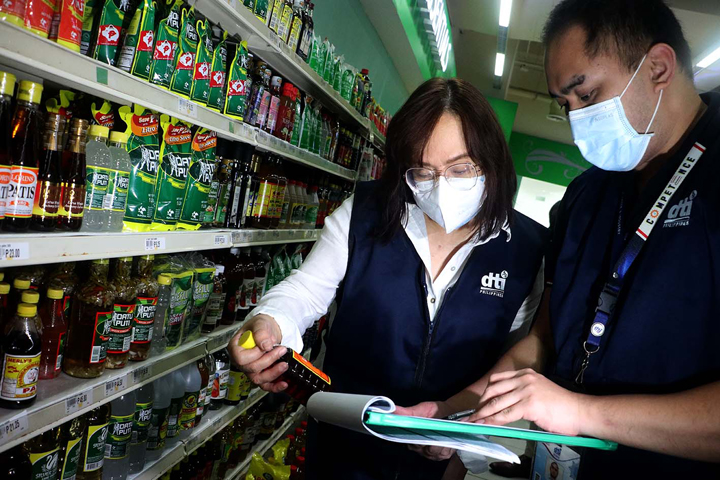
THE Department of Trade and Industry (DTI) said the prices and supply of basic necessities and prime commodities are “generally stable” based on its latest nationwide situational report.
“The prices and supply of basic necessities and prime commodities are generally stable based on the latest nationwide situational report,” Trade Secretary Alfredo E. Pascual said in a statement on Wednesday.
In a statement on Wednesday, the Trade department said it ensures the submission of daily situational monitoring reports from its provincial and regional offices following the onslaught of severe tropical storm “Paeng.”
As chairman of the National Price Coordinating Council, the Trade department said it is coordinating with the Philippine Chamber of Food Manufacturers which is composed of manufacturers and retailers of basic necessities and prime commodities (BNPC), to guarantee “timely and constant replenishment of goods” particularly in the typhoon-stricken areas.
Hence, the agency said it has been “continuously conducting intensified monitoring of prices and supply of BNPCs.”
So far, the areas that have been placed under a state of calamity based on Proclamation No. 84 issued by President Ferdinand “Bongbong” Marcos Jr. On Monday are Region 4A (Calabarzon), Region 5 (Bicol Region), Region 6 (Western Visayas), and the Bangsamoro Autonomous Region in Muslim Mindanao (BARMM).
Under Proclamation No. 84, the state of calamity (SOC) shall remain in force and effect for six months unless earlier lifted by the President.
According to Republic Act No. 7581 or the Price Act as amended, the prices of basic necessities are automatically frozen at their prevailing prices for 60 days once a state of calamity is declared in an area, unless sooner lifted by the President.
As part of the Trade department’s mandate, it monitors prices of canned fish, locally manufactured instant noodles, bottled water, bread, processed milk, coffee, candles, laundry soap, detergent, and salt under basic necessities.
Meanwhile, other implementing agencies under the Price Act ensure price stability and availability of supply for the products under their jurisdiction.
For instance, the Department of Agriculture (DA) is in charge of rice, corn, cooking oil, fresh, dried and other marine products, fresh eggs, fresh pork, beef and poultry meat, fresh milk, fresh vegetables, root crops, sugar, and fresh fruits; while the Department of Health takes care of essential drugs.
On Monday, DTI reminded business establishments in areas under a state of calamity to adhere to the price freeze on basic necessities.
The Trade chief said on Monday, “The DTI is closely coordinating with the Office of the Civil Defense [OCD] on the declarations of State of Calamity. Automatic price freeze shall apply to basic necessities. Establishments found violating the price freeze may be subjected to administrative cases and fines.”