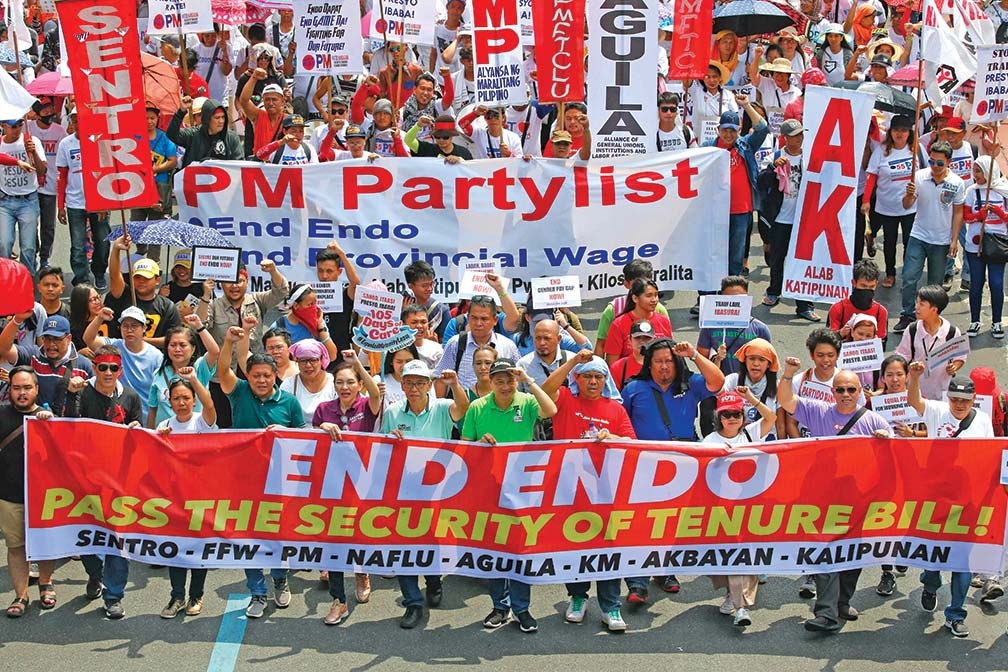

WITH his term now nearly over, President Rodrigo R. Duterte is still hounded by calls to make good on his key campaign promises to the labor sector.
Foremost of the commitments was to abolish contractualization, which organized labor viewed as a constant threat against their security of tenure.
Right after winning the presidency, Duterte instructed the Department of Labor and Employment (DOLE) to adopt stricter policies on the controversial work arrangement, while Congress crafts a law to institutionalize the reforms.
In the early years of his administration, DOLE conducted an aggressive campaign to weed out illegal forms of contractualization, resulting in the unprecedented mass regularization of workers.
Since 2016, Labor and Employment Secretary Silvestre H. Bello III said they were able to regularize around 800,000 workers.
It was a feat that even labor groups said was unheard of in previous administrations.
EO 51
Duterte also tried to come out with a policy to restrict contractual employment through his Executive Order 51 in 2018. However, except for a few provisions, the issuance only repeated provisions in the Labor Code on prohibiting illegal contractualization.
This includes allowing the National Tripartite Industrial Peace Council to declare activities which may be contracted out, as well as declaring as regular employees those workers whose employment was terminated.
Nagkaisa Labor coalition chairman and Federation of Free Workers (FFW) president Sonny Matula said both policies are far from being a game changer in restricting contractual employment.
Nevertheless, Matula, who is also a labor lawyer, said he cited the provision of EO 51 in his appeal to regularize several contractual workers who were illegally dismissed.
The outcome of the pending cases, Matula said, could serve as jurisprudence on the implementation of EO 51.
SOT bill
EO 51 was not meant to be a stand-alone policy and should have been complemented by the Security of Tenure (SOT) Bill, which was passed in the House of Representatives and the Senate after it was endorsed by Duterte himself during his State of the Nation Address (Sona) in 2018.
Both houses of Congress were finally able to come out with an SOT bill in 2019, which was submitted to Duterte for his consideration.
While the bill did not outrightly ban all forms of contractual employment, it expanded the scope of labor-only contracting, which is illegal.
It also imposed fines on companies engaged in illegal contractualization, provided a transition fund for displaced contractual employees, and required contractors to be licensed by DOLE.
Unfortunately, in July 2019, Duterte decided to veto the SOT bill, saying it destroyed the “delicate balance“ of employers and workers.
The abrupt change of Duterte on the bill enraged labor groups who called him out for his betrayal of his campaign promise.
“I think he will be remembered most as the President who hoodwinked workers into thinking that he will end contractualization,” Sentro ng Nagkakaisa at Progresibong Manggagawa (Sentro) secretary general Joshua Mata said in an interview.
After the veto, Duterte no longer mentioned the issue of contractualization in his public addresses, including his Sona in 2019 and 2020.
DOFIL
Instead, Duterte decided to focus on his other campaign promise of creating a new government agency to handle the affairs of Filipinos abroad: the Department of Overseas Filipinos (DOFIL).
Several government agencies, including economic managers, were initially against the policy due to the cost and possible disruption it will cause on public services for Filipinos abroad.
The opposition died down after Duterte insisted on the proposal in his 2019 Sona.
Still, migrant stakeholders, including some non-government organizations, remain steadfast in opposing DOFIL, which they noted will merely add another layer of bureaucracy for Filipinos abroad.
Currently, the law creating DOFIL is part of the priority legislation of the government.
Last Monday, Sen. Miguel Zubiri disclosed that DOFIL and other priority legislation are expected to be finalized by August or September.
Landmark achievements
While both the SOT bill and DOFIL were the most prominent pending policies, the current administration also passed major landmark labor-related policies.
These include Republic Act (RA) 11210 or the Expanded Maternity Law, RA 10771 or the Green Jobs Act, RA 11058 or the Occupational Safety and Health Law, and RA 111651 or the Telecommuting Law.
The last two have proven timely with the onset of the Covid-19 pandemic last year, which disrupted the operations of many businesses, forcing thousands of workers to work from home.
Also in response to the pandemic, the government was among the first countries to declare Covid-19 as a compensable occupational disease.
The government was also able to ratify Convention 151 of the International Labor Organization (ILO), which recognizes the right of government employees to organize.
Congress, however, has yet to come out with the necessary law to fully implement the said international convention.
Labor controversies
However, not all of the international attention painted the country in a positive light.
The International Trade Union Confederation (ITUC) tagged the country among the top 10 worst countries for workers due to the alleged rampant extra-judicial killings, which included those of labor unionists, in the last five years.
The government already accepted the request of the ILO to deploy a high-level mission to investigate the matter, but the probe has yet to commence.
The surge in migrant workers, mostly from China, employed by Philippine Offshore Gaming Operators (POGOs) also generated international interest.
Allegations that these migrant workers were being abused and they are taking employment opportunities from local jobseekers led to several investigations and policy reforms.
Lasting legacy
All of the cited achievements and failures of the administration in the labor front may ultimately be overshadowed by one of its biggest work-related endeavors yet: the National Employment Recovery Strategy (NERS).
Finalized only this year, the NERS is meant to help companies and their workers recover from the impact of quarantine restrictions in response to the pandemic.
The strategy consolidated all existing programs of the government, which targets to boost the employability of workers, particularly those displaced due to the pandemic.
In the May round of its displacement report, DOLE counted 1.1 million workers who were permanently and temporarily displaced amid the pandemic.
Last year, DOLE reported over 5 million workers as permanently and temporarily displaced.
The NERS focuses on upskilling and training of the displaced, and providing them with employment opportunities while at the same time helping companies retain their existing workers.
Former dean of the University of the Philippines-School of Labor and Industrial Relations Rene E. Ofreneo expressed concern, meanwhile, over the execution of the programs amid the pandemic.
He noted the government has yet to fully flesh out the programs of NERS, which will cover young entrants and those enrolled in various levels of the education system, including technical-vocational courses.
“What is really worrisome is how the government is addressing the human development side (skills upgrading, basic education, etc.) because this is the main arena of global competition in the 21st century. This is still not clear,” Ofreneo said.
In his view, it is this legacy of the administration which could help make or break the labor sector in the near future.
Last month, DOLE and 10 other government agencies signed an agreement for the creation of the Philippine Skills Framework, which aims to “formulate sector-specific skills to guide the country’s workers in enhancing their skill.” It could be a good start; but given how deeply the pandemic has plunged the labor sector into misery, the climb back to decent work situation for all is bound to take a long time.
Image courtesy of AP/Bullit Marquez