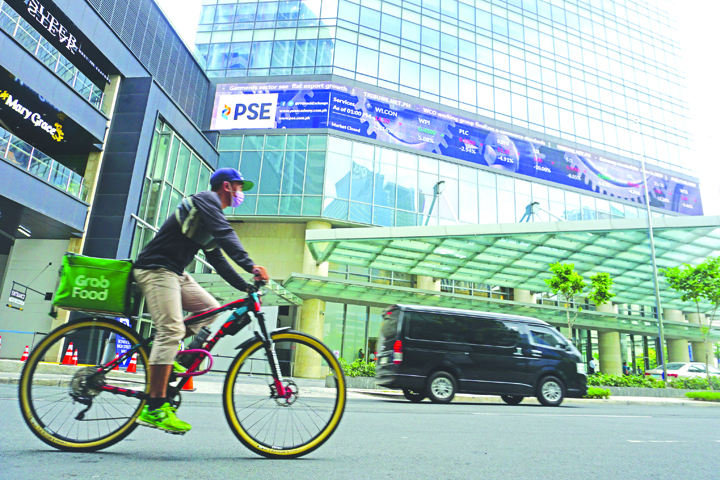
DESPITE the pandemic, trading in the stock market remained robust in the first quarter of the year as local investors have stepped up amid the drop in foreign participation, officials said on Monday.
Philippine Stock Exchange (PSE) President Ramon Monzon reported to the Capital Market Development Council (CMDC) a 49.6-percent jump in the average trading volume in the first quarter of this year compared to the same period last year, “indicating that local investors have stepped up” despite the significant decline of foreign participation in the stock market.
While foreign participation in the stock market slid to 25.7 percent in the first quarter of 2021 from 55.5 percent in 2019 and 45.4 percent in 2020, the year-to-date average daily value turnover in the PSE as of end-March this year hit P11 billion, higher than the average of P7.35 billion in 2020, and P7.29 billion in 2019.
“Market liquidity is off to a good start. Trading in the first quarter remains robust. We have almost a 50-percent increase in value turnover. Retail investors are very active in the stock market at least in the first quarter of 2021,” Monzon said during the CMDC meeting.
Tasked to facilitate the development of the Philippine capital market, the CMDC is chaired by Finance Secretary Carlos G. Dominguez III. Lawyer Benedicta Du-Baladad, former president of the Financial Executives Institute of the Philippines (Finex), and Securities and Exchange Commission (SEC) Chairman Emilio Aquino both cochair the CMDC.
Daily value turnover reached P11.04 billion in January this year, then went up to P12.35 billion in February and eased to P9.88 billion in March.
Local retail investors also accounted for 74.3 percent of stock market transactions as of end-March.
The PSE also reported that retail investors accounted for 43.3 percent of the volume traded by local investors compared to just 18.2 percent in 2019 and 26.9 percent in 2020.
Monzon said savings by retail investors who can neither travel nor spend because of the pandemic may have been diverted to investments in the equities markets.
Capital-raising activities in the PSE have also remained strong, with the year-on-year capital raised growing 116 percent to P41.63 billion in the first quarter of this year from last year’s P19.24 billion.
Monzon said the capital-raising pipeline remains “robust” despite the Covid-19 pandemic, with several companies having filed applications for an IPO or expressing interest in setting up their own Real Estate Investment Trusts (REITs).
Among the firms that have turned toward the equities market for their funding needs were DDMP REIT Inc., which raised P14.7 billion from its initial public offering (IPO); Cebu Air Inc., P12.5 billion from its stock rights offering (SRO); AC Energy Philippines, P5.37 billion from its SRO; and 8990 Holdings Inc., P3.7 billion from its follow-on offering (FOO).
Retail investors
Meanwhile, Philippine Dealing & Exchange Corp. (PDEx) President-CEO Antonino Nakpil reported that the fixed-income or debt securities market performed slightly lower in the first quarter compared to the same period last year, but investor-related trading made up 59 percent or P898 billion of the total volume of P1.5 trillion as of end-March this year.
For his part, SEC Commissioner Ephyro Amatong, a CMDC member, noted that retail investors have kept liquidity high in both the fixed-income and equities markets.
In response, Dominguez said the increase in retail investor participation in both markets point to the trust and confidence of the public in the regulatory bodies that are tasked to keep their capital and investment returns safe. “Let’s keep that in mind—the environment of confidence in the system. Regulators are so important to provide guarantees to investors and ensure them that they are not going to be cheated,” Dominguez told fellow CMDC members during the meeting.
National Treasurer Rosalia V. de Leon, also a CMDC member, attributed the growing number of retail investors in fixed-income securities to the measures that had been put in place to make bonds accessible to small investors, and the successful financial literacy campaigns of the Bangko Sentral ng Pilipinas, SEC and the Philippine Dealing System Holdings Corp.
Nakpil also said secondary market trading was active despite the rise in the benchmark interest rates, particularly in the 10-year Philippine Treasury Bond yields which rose from 3 percent in January to 4.5 percent in March 2021, in line with a similar trend in US 10-year Treasury yields.
For primary issuance activity in the corporate bond markets, Nakpil said new bond listings in the first quarter of the year reached almost P59 billion, but due to the number of maturing bonds in the same period, the overall amount of listed bonds of P1.45 trillion was lower than P 1.47 trillion as of end-2020.
Among the securities listed in the first quarter were SM Prime’s P10-billion fixed rate bonds (FRBs), Chinabank’s P20-billion FRBs, and the Rizal Commercial Banking Corp. (RCBC)’s P17.87-billion ASEAN Sustainability Bonds.