

FOUR days before President Marcos Jr. meets US President Joe Biden in the White House, the Philippine Coast Guard (PCG) has reported series of alleged violations by the Chinese Navy and its militias in Philippine-claimed West Philippine Sea (WPS).
In a Facebook post, the PCG said its vessels BRP Malabrigo and BRP Malapascua patrolled the waters off Sabina Shoal, Iroquis Reef, Lawak, Patag, Likas, Parola, Pag-asa, Tizzard Bank, Julian Felipe Reef, and Ayungin Shoal from April 18 to 24.
“Throughout the mission, the PCG vessels identified over 100 alleged Chinese Maritime Militia [CMM] vessels, a People’s Liberation Army Navy corvette class and two China Coast Guard vessels,” the PCG said. Eight of the Chinese militia vessels were monitored near Sabina Shoal.
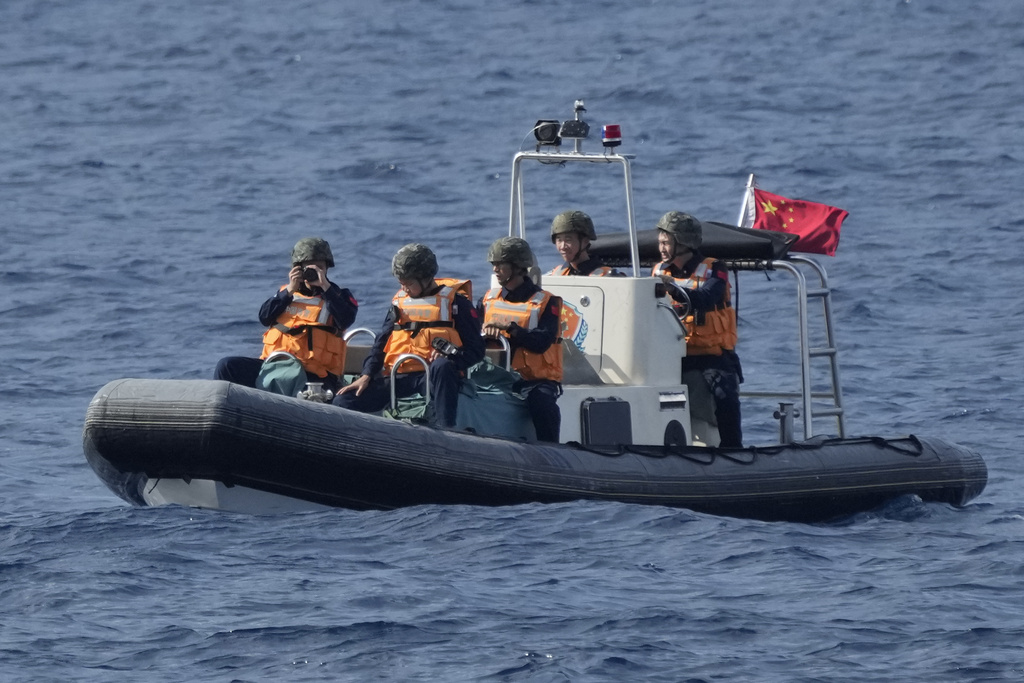
“Despite the numerous radio challenges by the two PCG vessels, the CMM did not respond or comply with the order to leave the area immediately,” it added.
Off Pag-asa Island, the biggest island held by the Philippines in the disputed South China Sea, four more Chinese militias were caught engaged in fishing. The PCG said the Chinese militias were “successfully driven away” from the island.
At Julian Felipe Reef, the PCG also saw another group of 17 Chinese militias.
“In response, the PCG vessels deployed their Rigid Hull Inflatable Boats [RHIB] to disperse the large CMM gathering. However, no CMM vessels reacted or made any attempts to vacate the area,” it said.
Chinese Navy, PCG ‘confrontation’ near Pagasa Island
On Friday, April 21, a Chinese People’s Liberation Army (PLA) Navy vessel with bow number 549 crossed paths with the PCG vessels.
The confrontation took place at a distance of seven nautical miles from Pag-asa Island.
The encounter began when the Chinese gray ship challenged the presence of the PCG vessels over the radio and directed them to leave the area.
The Chinese navy issued a warning to the PCG, suggesting that failure to comply might “cause problem.”
“Despite this, the PCG vessels did not back down and responded by asserting their rights to carry out operations within the territorial sea of Pag-asa Island. They further asked the Chinese navy to leave the area immediately instead,” the PCG said.
‘Aggressive tactics’ near Ayungin Shoal
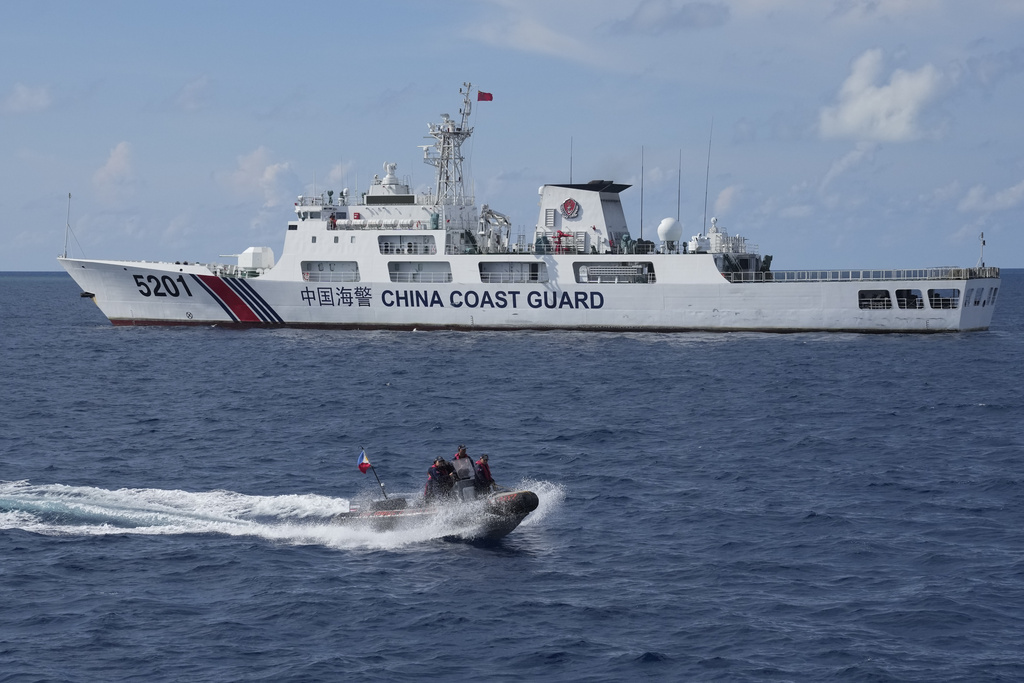
Two days after the Pag-asa Island confrontation, on April 23, two Chinese Coast Guard (CCG) vessels intercepted the PCG vessels that were in the vicinity of Ayungin Shoal.
PCG identified two Chinese Coast Guard vessels with bow numbers 5201 and 4202 which “exhibited aggressive tactics” against BRP Malapascua and BRP Malabrigo.
“CCG vessel 5201 was reported to have carried out dangerous maneuvers near BRP Malapascua, maintaining a perilous distance of only 50 yards. This close proximity posed a significant threat to the safety and security of the Philippine vessel and its crew,” the PCG said.
The other Chinese vessel 4202 “persistently followed” BRP Malabrigo at a distance of 700 yards.
“The China Coast Guard’s interference with this routine patrol mission was totally inconsistent with freedom of navigation, and a number of documented incidents also involved highly dangerous maneuvers that were contrary to standard navigational practices,” DFA spokesperson Ma. Teresita Daza said.
Daza called on China to “respect the Philippines’ rights over the WPS, as provided by UNCLOS, and refrain from actions that may cause an untoward incident.”
Beijing: Philippine Coast Guard initiated the Ayungin near-clash
The Chinese foreign ministry, meanwhile, accused the PCG of “premeditated, provocative action” that caused the near-crash in Ayungin Shoal.
The Philippine foreign ministry spokesperson said, “Routine patrols in our own waters can neither be premeditated nor provocative.”
“It is a legal right that we exercised and will continue to exercise,” Daza said.
The DFA is mulling over filing of diplomatic protest against China for these latest incidents.
Image credits: AP/Aaron Favila