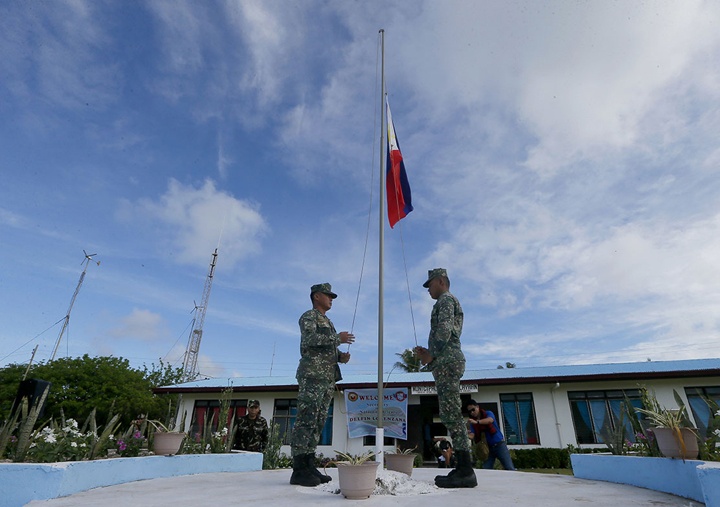
SECRETARY of State Antony J. Blinken on Wednesday repeated a previous commitment by the United States under the Mutual Defense Treaty (MDT) to support claimants to the contested waters of the South China Sea, in the face of continuing aggressive behavior by China.
The Asian giant two days ago issued a controversial law that authorizes its coast guard to fire on foreign vessels and destroy other countries’ structures on islands it claims. Foreign Affairs Secretary Teodoro L. Locsin Jr. fired off a diplomatic protest over the new law, which he said cannot remain unchallenged given the context of China’s bullying in the South China Sea.
“Secretary of State, Antony Blinken pledged to stand with Southeast Asian claimants in the face of PRC pressure,” said Spokesperson Ned Price in a statement following Blinken’s conversation with Locsin.
“The two secretaries committed to continue building upon a relationship founded on shared strategic interests and history, democratic values, and strong people-to-people ties,” the statement said.
In his exchange with Locsin, Blinken affirmed that a strong US-Philippine Alliance is vital to a free and open Indo-Pacific region.
Blinken stressed the importance of the MDT for the security of both nations, and its clear application to armed attacks against the Philippine armed forces, public vessels, or aircraft in the Pacific, which includes the South China Sea.
The secretary of state also said the US rejects China’s maritime claims in the South China Sea to the extent they exceed the maritime zones that China is permitted to claim under international law, under the 1982 United Nations Convention on the Law of the Sea (Unclos).
On Wednesday, Locsin tweeted that the new Chinese law “is a verbal threat of war to any country that defies” it, adding that failure to challenge the law “is submission to it.”
The DFA chief said that “while enacting law is a sovereign prerogative, this one—given the area involved, or for that matter the open South China Sea—is a verbal threat of war to any country that defies the law.”
China’s Coast Guard Law, passed on January 22, empowers the seaborne force to “take all necessary measures, including the use of weapons, when national sovereignty, sovereign rights, and jurisdiction are being illegally infringed upon by foreign organizations or individuals at sea.”
The law also authorizes the coast guard to demolish other countries’ structures built on reefs and islands claimed by China and to seize or order foreign vessels illegally entering China’s territorial waters to leave.
Aside from the Philippines and China, other claimants to the strategic waters are Vietnam, Malaysia, Brunei and Taiwan.
Vital to commerce
The Chinese Coast Guard law is seen to increase tension in the area, where an estimated $3 billion worth of seaborne trade passes through yearly, aside from oil and gas beneath the waves that remains to be tapped.
However, the Philippines and China are in a discussion to exploit the oil and gas resources in the West Philippine Sea and have agreed to a 60-40 sharing scheme, where the larger share goes to the Philippines.
The six littoral states have been engaged in territorial rivalries in the South China Sea for decades, and some countries are seen to accede to China’s demand for bilateral negotiations.
Although it has no stake in the SCS, the United States Navy continues to challenge the Asian giant, deploying a flotilla of warships frequently, calling the move freedom of navigation operations (Fonops), allegedly to keep the 3.5 million square miles open to trade and commerce.
China’s 9-dash line, swinging in a roughly U-shape pattern covering the entire 3.5 million square miles of the SCS, has been declared illegal by the International Tribunal in The Hague, following a 2016 ruling on a case filed by Manila.
China has ignored the ruling and continued an island-building spree that began in 2013, and transformed seven disputed reefs in the Spratlys into military installations. The Chinese built runways, radar installations and missile batteries, which remain unchallenged by the small littoral states.
The Association of Southeast Asian Nations (Asean) have been crafting a code of conduct (COC) for almost a decade, to spell out the proper behavior of the claimants in the SCS, and prevent all-out conflict. However, the coronavirus pandemic which started early in 2020 has delayed the talks.
Five days ago, a US Navy aircraft carrier, the USS Theodore Roosevelt, sailed into the South China Sea on “routine operations,” to promote freedom of the seas and reassure America’s allies, Rear Admiral Doug Verissimo said in a statement.
Blinken was recently confirmed by the US Senate as President Joseph Biden’s Secretary of State.
Formerly, he had served as Deputy National Security Advisor from 2013 to 2015 and Deputy Secretary of State from 2015 to 2017 under President Barack Obama.