Typhoon Odette slammed into the southeastern Philippines on Thursday and was blowing across island provinces where nearly 100,000 people have been evacuated from high-risk areas that could be devastated by flash floods, landslides and tidal surges, disaster officials said.
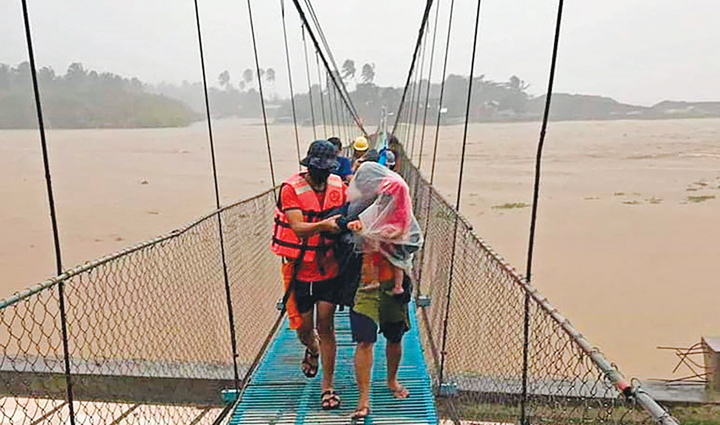
Forecasters said Odette (international code name Rai), which had sustained winds of 185 kilometers per hour (km/h) and gusts of up to 230 km/h, blew from the Pacific Ocean into the Siargao Islands. There were no immediate reports of casualties or major damage, but military and Philippine Coast Guard (PCG) rescue personnel were helping residents stranded by fast-rising waters.
Disaster-response officials said about 10,000 villages lie in the projected path of the typhoon, which has a 400-kilometer-wide rain band and is one of the strongest to hit the country this year.

PCG said it has grounded all vessels, stranding nearly 4,000 passengers and ferry and cargo ship workers in dozens of southern and central ports. Several mostly domestic flights have been canceled and schools and workplaces were shut in the most vulnerable areas.
Disaster response personnel continued to rescue and move away residents from flood-hit and threatened villages amid the raging typhoon, which has pummeled the Visayas and some parts of Mindanao and Southern Luzon with strong wind and rain.
In Tubigon, Bohol, Coast Guard personnel ferried residents to higher grounds, while its other members rescued villagers living near the swollen Osmeña Creek in Cagayan de Oro City. The PCG also preemptively evacuated residents of Poblacion 1 and 2 in Tubay, Agusan del Norte.
As of Thursday morning, the National Disaster Risk Reduction and Management Council (NDRRMC) said that at least 4,615 families in Samar, Eastern Samar, Leyte, Biliran, and Southern Leyte have been moved to safer areas. Another 28, 228 people were also preemptively evacuated in Dinagat and Surigao and Agusan provinces.
Local officials in the affected provinces reported cases of flooding and landslide in some areas due to heavy rains and strong winds, which is affecting a large portion of the country, forcing the cancellation of classes and government work in the severely threatened and hardest-hit areas.
In Caraga, powerful winds wrecked structures hours even before the typhoon could make its forecasted landfall.
Early video posts from disaster monitoring agencies of Surigao del Sur, Surigao del Norte and Agusan provinces showed strong winds plucking off roofs of houses.
Water levels have surge in major rivers in Caraga, which was placed on a red warning.
The PCG has monitored a total of 4,358 passengers, drivers and cargo helpers; 1,969 rolling cargoes; 90 vessels and nine motor banca stranded in Bicol, Central Visayas, North Eastern Mindanao, Eastern Visayas and Western Visayas.
Another 254 vessels and 137 motor banca are taking shelter as a precautionary measure against the possible threat of the typhoon.
Typhoon Odette is the second strongest typhoon to hit Mindanao after Typhoon Pablo, which hit Mindanao in 2012.
Pablo, with sustained winds of 280 km/h, was a Category 5 typhoon, which killed at least 1,500 people.
Typhoon Sendong, although packing a 95 km/h wind, brought a much destructive impact in 2011 with about 2,000 dead or missing in northern Mindanao.
Gov. Ben Evardone of Eastern Samar said he suspended vaccinations in his region of nearly half a million people due to the typhoon.
More than 70 percent of villagers in the province have gotten at least one shot, and Evardone expressed concern because some vaccines stored in Eastern Samar will expire in a few months.
Overcrowding is unavoidable, he said, in the limited number of evacuation centers in his province, where more than 32,000 people have been moved to safety.
“It’s impossible to observe social distancing, it will really be tough,” Evardone told The Associated Press.
“What we do is we cluster evacuees by families. We don’t mix different people in the same place as a precaution.”
About 20 storms and typhoons batter the Philippines each year. The archipelago is also located in the seismically active Pacific “Ring of Fire” region, making it one of the most disaster-prone countries in the world.
The Philippine Red Cross said it is closely monitoring the typhoon situation after Chairman and CEO Sen. Richard Gordon instructed all local chapters to prepare for Typhoon Odette.
All PRC staff and volunteers from Cebu, Passi, Aklan, Bohol, Lapu-Lapu chapters were activated and on standby for possible deployment. AP, Rene Acosta, Manuel T. Cayon and Claudeth Mocon-Ciriaco