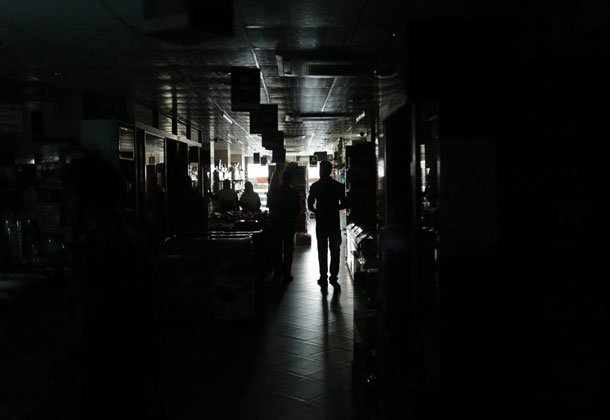
SOME areas in Luzon experienced power outage for at least an hour on Monday due to insufficient power supply and reserve, shaving off 3,771 MW of capacity from the grid.
The National Grid Corp. of the Philippines (NGCP) placed the Luzon grid on yellow alert from 11 a.m. to 1 p.m. and from 3 p.m. to 4 p.m. In between, a red alert notice took effect from 1 p.m. to 3 p.m.
A yellow alert means power reserves have dropped below the minimum 647 MW, but does not necessarily mean there will be power outages. A red alert means there is insufficient power supply in the grid. Rotational brownouts are expected to occur.
The Luzon grid’s capacity stood at 11,729 MW while peak demand hit 11, 514 MW, leaving a deficit of 215 MW.
The total unavailable capacity as of Monday is broken down into: 1,838 MW of power plant derating, 1,498 MW of unplanned outage and 435 MW of planned outage.
Among the plants that went on unplanned outage are Sual 2 (647 MW) and CBK units 1 and 2 (22 MW). Also, GN Power Mariveles 1 (345 MW) and Calaca 2 (300 MW) were on extended planned outage.
San Roque units 1-3 (435 MW) are still on planned outage. It should have been back online end-May, but will resume
operations on June 13.
Meanwhile, the capacity of Ilijan (1,200 MW) was reduced to 716 MW due to Malampaya gas restriction. There are other power plants, mostly hydro and geothermal, with derated capacity.
DOE cites extended plant outage
The Department of Energy (DOE), which earlier assured the public that they there won’t be any red alert notice, said in a press briefing Monday afternoon the extended planned outage of Sual 2, CBK units, GN Power Mariveles and Sem-Calaca Power triggered the red alert notice.
“We haven’t hit our demand forecast yet of 11,840 MW. In fact, highest demand was achieved last Friday at 11,760 MW. The extended outage of some power plants brought us to red alert level because the reserve level we have now is only around 400 MW. So, that’s within the red alert. We need to maintain more than 400 MW to ensure that there won’t be any rotational outage,” said DOE Assistant Secretary Redentor Delola.
Sual 2, which was supposed to be back online end-May, will be offline until the third week of June.
GN Power Mariveles unit 1 will be back on July 28 while Sem-Calaca2 will be online on July 1. The resumption of CBK has yet to be announced.
“The cause of the lack of reserve that we’re facing is really…the delay of some big plants. They were supposed to be back already but were extended. Sem Calaca has been out since December last year. GN Power Dinginin [668 MW], which we expected as additional capacity, is still under commissioning and testing,” explained Delola.
The lack of power reserves prompted the NGCP to implement Manual Load Dropping (MLD) in parts of La Union, Ilocos Norte, Quezon, Zambales, Camarines Norte, Albay and Metro Manila.
Meralco areas affected
Separately, the Manila Electric Company (Meralco) released a list of tentative areas affected by the MLD from 1 p.m. to 3 p.m. These include certain areas in Bulacan, Cavite, Laguna, Rizal and Metro Manila.
In the metropolis, affected areas under Meralco franchise are some areas in the cities of Caloocan, Manila, Pasay, Parañaque, Pasig, Quezon City and Taguig.
However, Meralco said 86 ILP (Interuptible Load Program) participants, equivalent to a combined capacity of 168 MW, have confirmed willingness to deload. ILP works by asking companies to use their own generating facilities when power is in short supply and reserves. This helps mitigate the energy supply deficiency in the country.
DOE-Electric Power Industry Management Bureau Director Mario Marasigan said that demand increases by 100 MW for every degree increase in temperature—a very real risk these days as temperatures continue to reach sizzling levels.
DOE official said yellow and possibly red alert would be issued in the weeks to come.