
By Jessie D. Guest / University of South Carolina
AS many children go back to school after months of global pandemic, social isolation and on-and-off remote learning, they too are feeling the additional stress and uncertainty of these times.
Children need play to decompress and communicate in ways that are meaningful to them. Play is how they express themselves, process their day and solve problems. It’s essential for their social, emotional, creative and cognitive well-being. Play helps teach them self-regulation, boundary setting and decision-making.
As a licensed clinical mental health counselor and registered play therapist and supervisor, I spend a lot of my time helping people understand children. I show adults how to see the world through kids’ eyes and how to engage them on their level.
After so much isolation and increased demands on parents and families during the Covid-19 pandemic, I believe now is an important time for parents and caregivers to increase their understanding of, communication with and connection to their children—through play.
STRUCTURED VS. UNSTRUCTURED PLAY
THERE are two main types of play that provide cognitive and emotional benefits for kids—structured play and unstructured play, or free play.
Structured play—such as board games, puzzles and individual or team sports—involves instructions and follows a set of rules. An objective or purpose of the play is established. Structured play helps children learn to manage their emotions, take turns, follow rules and deal with feelings of frustration as well as feelings of success.
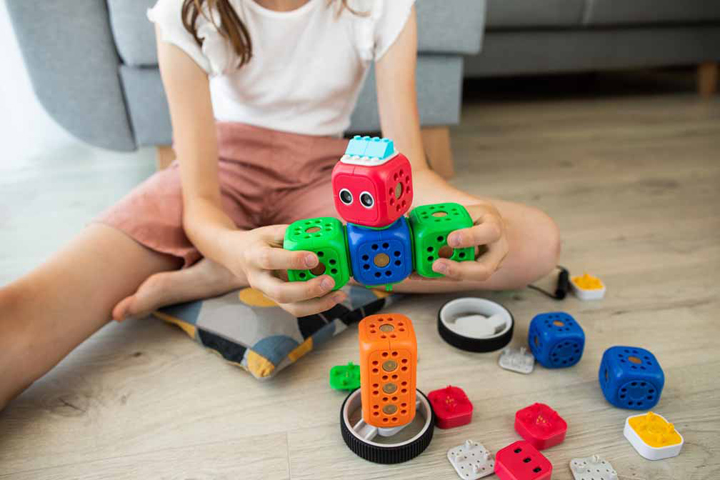
Unstructured play, also called free play, encourages children to do what interests them without adult direction. It doesn’t require an outcome or product. Unstructured play allows the child’s brain to recover from a highly structured school day and provides a sense of freedom. It fosters problem-solving, resilience and creativity, and gives kids time and space to make sense of their experiences. Examples of unstructured or free play include fantasy play, painting, playing made-up games with others and building with blocks.
FREE PLAY TIPS
ALTHOUGH free play is child-led, parents can engage with their child during this time. Here are five tips based on Sue Bratton and Garly Landreth’s child-parent relationship therapy, which uses play to build stronger and healthier parent-child attachment.
1. Get on their level. Create a space on the floor with some of their toys or join them in their play area. Sit on the ground with them. Let them know that this is their “special play time.” This time is special because the parent is engaging with the child in a very different way than other interactions throughout the day.
2. Allow the child to lead. Allow the child to direct the play. If asked what to play, try responding, “You get to decide what we play today.”
3. Show interest. Parents can do this by providing feedback. State what you see your child is doing without any notion of acceptance or approval: “You’re playing with the doll” or “You’re coloring that red.” Repeat back what your child says: “Cars go fast” or “Yellow is your sister’s favorite color.” Reflect the feelings that your child is expressing: “You feel happy when your car wins” or “You’re mad when you lose the race.” This type of responding illustrates the parent’s engagement without taking over the play.
4. Set limits and boundaries. Play that is child-led does not mean the child can break toys or hurt themselves or others. Sometimes the parent may need to step in and set a limit if the child’s behavior becomes destructive or harmful. Be sure to validate the feeling the child is exhibiting and provide another option for that behavior. For example: “You are mad right now, but people aren’t for hitting. You can hit the stuffed animal instead.”
5. Be consistent. Children thrive on stability and consistency. Try to implement the “special play time” each week for about 30 minutes and use a timer to ensure the amount of play time is consistent and your child is prepared for the ending. This special play time should take place regardless of behavior and should not be used as a punishment or reward.
THE CONVERSATION
Image courtesy of Robo Wunderkind on Unsplash