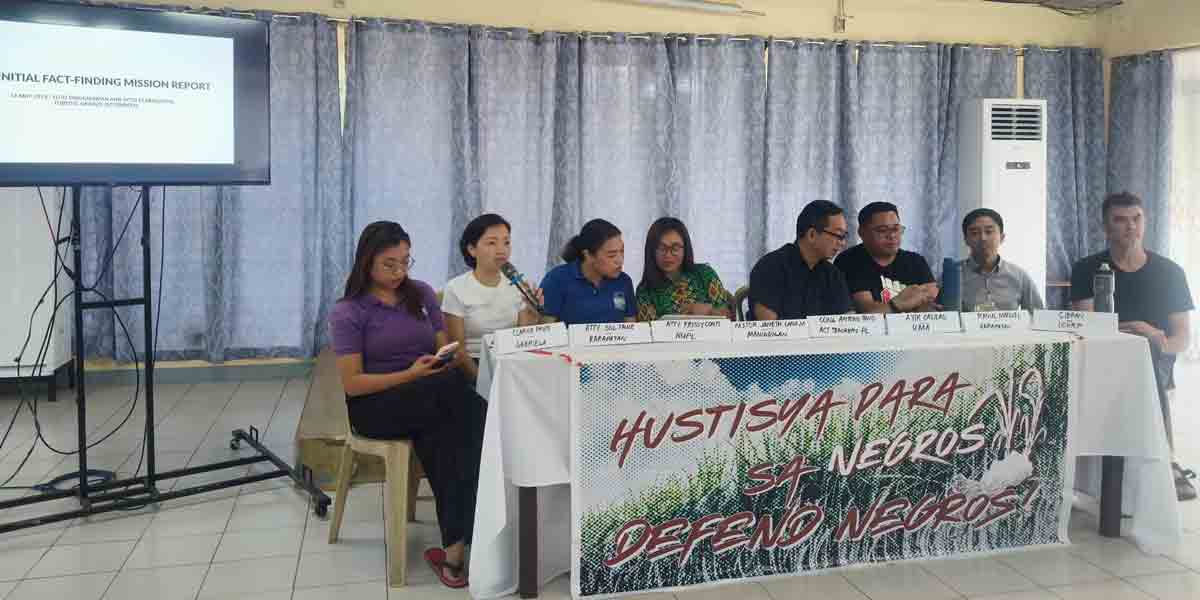
BACOLOD CITY — A delegation of more than 100 representatives from local, national, and international organizations gathered here recently to present the findings of the National Fact-Finding and Solidarity Mission (NFSM) on the April 19 killings in Toboso, Negros Occidental, which left 19 people dead during an alleged military operation.
The mission, led by the human rights alliance Karapatan and the Negros-based church network Manindigan Negros, challenged the official military narrative surrounding the incident, citing witness testimonies, initial forensic findings, and accounts from residents that point to possible violations of international humanitarian law (IHL).
In the early hours of April 19, a military operation conducted by the 79th Infantry Battalion of the Philippine Army took place in Sitio Sinugmawan, Barangay Salamanca, Toboso.
Residents reported hearing sustained gunfire until around 7 a.m. The operation reportedly continued toward Sitio Plaringding, where intermittent firing was heard from as early as 9 a.m. until later in the afternoon.
The operation resulted in the deaths of 19 people. The Communist Party of the Philippines confirmed that 10 of those killed were members of the New People’s Army (NPA), while the mission identified the remaining nine as civilians.
Among those killed were Alyssa Alano, University of the Philippines-Diliman University Student Council councilor; RJ Nichole Ledesma, a Bacolod-based community journalist; Errol Wendel, staff member of Unyon ng Manggagawa sa Agrikultura (UMA); Maureen Santuyo, a peasant organizer; and Filipino American activists Lyle Prijoles and Kai Sorem.
Raoul Manuel, former Kabataan Party-list representative and current National Council member of Karapatan, said the mission gathered evidence through focus group discussions, interviews, documentation, and the review of initial autopsy reports and witness accounts.
Sol Taule, deputy secretary general of Karapatan and legal counsel for the mission, said initial findings indicate that several victims were already hors de combat, or out of combat, when killed, raising concerns over possible IHL violations. Taule also flagged indications of possible tampering of evidence.
The mission further documented alleged abuses committed during and after the military operation. These included the forcible use of civilian homes as military encampments, harassment and intimidation of residents under counterinsurgency operations, and restrictions on farming activities.
Delegates also cited indiscriminate firing near civilian areas, illegal detention, and the alleged use of a farmer as a human shield.
In a solidarity message, the Most Rev. Gerardo Alminaza, bishop of the Diocese of San Carlos, condemned the continued militarization of communities in Negros, warning that “truth itself becomes vulnerable” amid escalating violence on the island.
He emphasized that civilians must always be protected, and renewed calls for the resumption of peace negotiations between the Government of the Republic of the Philippines (GRP) and the National Democratic Front of the Philippines (NDFP) to address the root causes of armed conflict. Formal talks between the two parties have been stalled since 2019.
Pastor Janeth, a church leader and peace advocate from Manindigan Negros, also echoed the call to condemn the violence and militarization in Negros.
Ariel Casilao, national chairperson of UMA and former Anakpawis Party-list representative, discussed the broader agrarian struggle in Negros. He confirmed that Wendel and Santuyo had been sent to investigate an agrarian dispute involving Hacienda Bedonia in Barangay Salamanca prior to the operation.
“Negros has been the massacre capital of human rights and international humanitarian law violations,” Casilao said, recalling previous incidents such as the Sagay 9 killings in 2018 and the Fausto family massacre in 2023.
Clarice Palce, representative of the Gabriela Alliance of Filipino Women, discussed the psychological impact of the incident on children in the affected communities.
Based on findings gathered with the Children’s Rehabilitation Center, many children continue to suffer trauma and panic attacks after witnessing what they described as an “all-out war” because of indiscriminate firing in the area.
Palce said the children also expressed fear over the continued military presence in their communities and called for the immediate pullout of government troops.
Human rights lawyer Krissy Conti of the National Union of Peoples’ Lawyers (NUPL) criticized the Armed Forces of the Philippines (AFP) for what she described as repeated violations of international humanitarian law and the rules of war.
Members of the fact-finding mission also reported experiencing harassment during the conduct of the investigation. Delegates said they were followed by an unidentified individual on a motorcycle who photographed the convoy’s vehicles.
During a courtesy visit at the Barangay Hall of Barangay Salamanca, several unidentified individuals were also seen openly taking photographs of the delegates, raising concerns over surveillance and intimidation against independent human rights investigators.
Residents additionally reported the continued presence of the 79th Infantry Battalion in the area in the days leading up to the mission.
The mission also raised concern over the reported blacklisting of Sadie Stone, an American pastor and member of the International Coalition for Human Rights in the Philippines (ICHRP), who was allegedly denied entry into the Philippines for supposed participation in “political activities” in 2016. Stone was scheduled to join the solidarity mission in Negros.
The delegation condemned what it described as the AFP’s continued denial of civilian casualties and called for accountability from the military, an end to militarization in Negros, and justice for the victims of what advocates have referred to as the “Negros 19 massacre.”
“The acts that terrorize and endanger civilians constitute grave violations of international humanitarian law, including the Geneva Conventions,” the mission said in its statement. (Juliane Judilla via tdg photo by tdg)