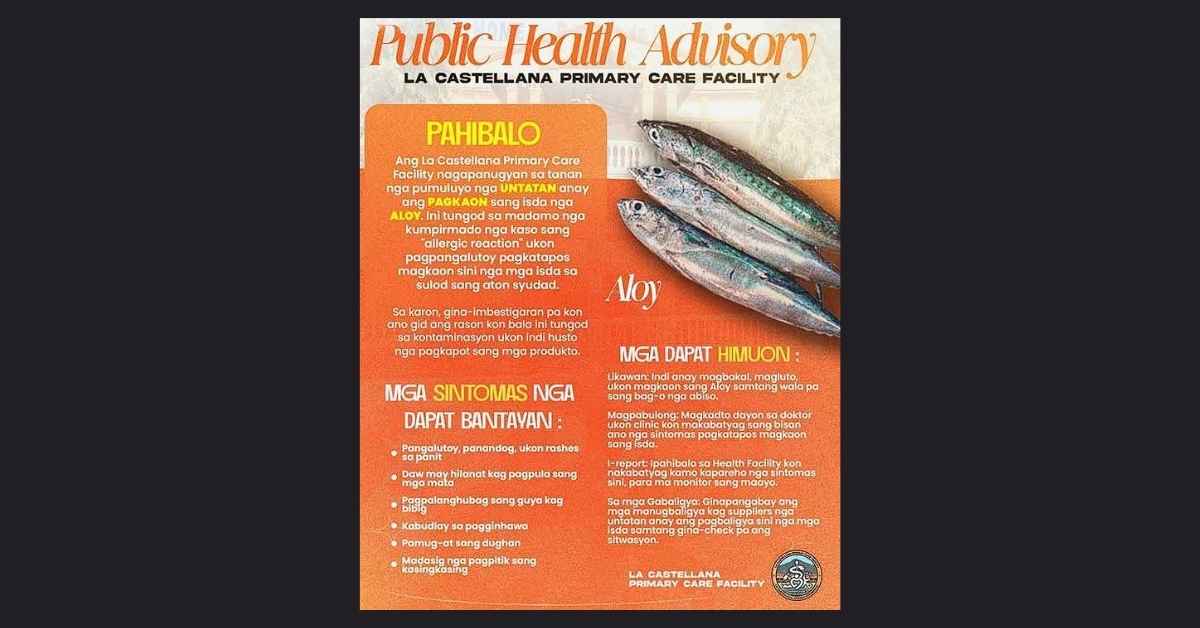
BACOLOD CITY — The municipalities of La Castellana and Hinigaran in Negros Occidental have issued advisories urging residents to temporarily refrain from eating tulingan, locally known as aloy, following a spike in allergic reactions linked to the fish, with more than 50 cases reported in Cadiz City.
La Castellana Vice Mayor Rhumyla Nicor-Mangilimutan announced on social media Tuesday that the town had recorded allergic reaction cases tied to the fish, a type of tuna.
A public advisory released Wednesday confirmed at least four cases in La Castellana.
In Hinigaran, three individuals experienced allergic reactions after eating the fish Monday.
The Hinigaran Municipal Health Office advised residents to avoid the fish as a precautionary measure.
“This is to formally advise the general public, market vendors, and seafood suppliers in Hinigaran, Negros Occidental regarding a temporary prohibition on the selling and consumption of aloy fish, effective immediately,” the advisory stated.
Authorities said investigations are ongoing to ensure public safety.
The Bureau of Fisheries and Aquatic Resources–Negros Island Region (BFAR-NIR) is monitoring reports of food poisoning cases in Cadiz City linked to tulingan consumption, with preliminary findings pointing to Scombroid Fish Poisoning.
Scombroid fish poisoning occurs not from a naturally occurring toxin in the fish, but from improper chilling from the time of catch to the point of sale.
“When fish like aloy or tulingan are left in the heat, they produce high levels of histamine, which cannot be removed even by cooking or frying,” BFAR-NIR said.
The agency warned that extreme heat in recent weeks has accelerated fish spoilage when handling protocols are not followed.
BFAR-NIR advised the public to keep fish clean, chill it immediately after purchase, and avoid exposing it to high temperatures to prevent bacterial growth.
Consumers were also cautioned against buying or eating fish with a metallic or peppery taste, a pungent smell, or soft, mushy flesh — all signs of histamine buildup from improper storage.
Scombroid poisoning, also called histamine poisoning, is a foodborne illness caused by improperly stored fish from the Scombridae family, which includes tuna, mackerel, and bonito. Symptoms typically include flushing, rash, headache, and gastrointestinal distress, and usually appear within minutes to an hour of consumption.
BFAR-NIR said it is working with the Cadiz City local government and conducting monitoring of wet markets across the province to ensure food safety.
The Cadiz City Health Office had earlier reported more than 50 individuals who experienced allergic reactions after consuming the fish Monday.
The fish was transported from Iloilo and originally sold to local dried fish producers for processing, but was later sold as fresh fish in the local market. (Glazyl M. Jopson via tdg photo by tdg)