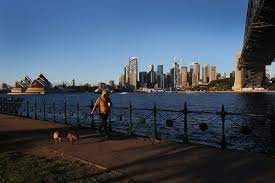

A two-week lockdown of Sydney will be extended for at least another seven days as authorities race to stamp out an outbreak of the Delta variant that’s grown to more than 350 cases since mid-June and has spread to an aged-care facility.
Current stay-at-home orders—except for exercise, essential shopping and medical care—will remain in place in Greater Sydney until midnight on July 16, New South Wales state Premier Gladys Berejiklian told reporters Wednesday. The lockdown was originally scheduled to end on Friday.
“This Delta strain is a game changer,” Berejiklian said when announcing the extension. “What we want to do is give us our best chance of making sure this is the only lockdown we have until the vast majority of our citizens are vaccinated. We know the vaccine is the key to our freedom.”
Sydney recorded 27 new cases in the community from the day before, with 13 of those in isolation during their infectious period. The infections include one resident and one staff member of an aged-care facility; Berejiklian said her government is considering whether to take “further actions” to restrict movements in areas of Sydney where the city’s new cases are most concentrated.
The lingering lockdown of some 6 million Australians during school holidays is a blow to the domestic tourism industry and yet again shows the limitations of the government’s strategy of trying to eliminate community transmission of the virus. While economies such as the U.K. and US are preparing to open up, Australia’s international borders remain largely closed to non-residents and comparatively small clusters of the coronavirus make even domestic travel difficult as states and territories pull up the drawbridge.
The Australian Formula 1 Grand Prix that was scheduled to take place in Melbourne in late November has been canceled “due to restrictions and logistical challenges” relating to the pandemic, organizers said in a statement Tuesday.
A sluggish vaccine rollout is being blamed for the ongoing disruption. The nation has administered 8.4 million doses, only enough to fully cover an estimated 16.5 percent of the population, according to Bloomberg’s Covid-19 Vaccine Tracker. That compares with the US at 51.7 percent and the U.K. at 59.4 percent.
The program has been hampered by confused messaging over the health risks of the AstraZeneca Plc. shot and supply-chain hold-ups from contracted drug-makers. The government has announced a four-phase plan to move from its current “Covid-zero” strategy to fully re-opening borders and living with the virus, but has provided no timeline.
That’s putting Prime Minister Scott Morrison, who faces elections next year, under pressure. Morrison’s personal approval rating has slipped from 57 percent to 51 percent, a Guardian Essential poll published Tuesday showed. A Newspoll published last week showed his conservative coalition had slipped 2 percentage points to trail the main opposition Labor party, 49 percent to 51 percent.
Key developments:
Indonesia’s oxygen shortfall
Indonesia reported another deadliest day in the coronavirus pandemic as hospitals become overwhelmed and local oxygen supply struggles to keep up with surging demand.
There were 31,189 confirmed cases in the 24 hours through midday Tuesday, with 728 people dying from the disease known as Covid-19. Southeast Asia’s virus hot spot has breached fresh records in infections and fatalities for three straight days.
South Korea’s most daily cases in 7 months
South Korea reported 1,212 new Covid-19 cases, the highest daily tally in almost seven months, as eased social distancing measures led to outbreaks at entertainment venues and shopping malls in the capital Seoul.
The latest surge comes as Korea stepped up vaccinations, helping moderate severe cases and deaths, health authorities said. About 30 percent of the population have received at least one dose while about 11 percent have been fully vaccinated.
Separately, Prime Minister Kim Boo-kyum said Korea will maintain its current social distancing measures for another week but may raise the level if the latest surge isn’t contained in the next two or three days. Seoul earlier this week rescinded easing certain restrictions such as wearing masks outdoors and banned outdoor drinking past 10 p.m.
Singapore not counting Sinovac users
Singapore isn’t counting people who took the Sinovac-CoronaVac vaccine in its national count, according to the Ministry of Health.
Only people who have taken Moderna Inc. and Pfizer Inc. shots are reflected in the overall vaccination numbers, a spokesman for the ministry said. Sinovac takers are included in a national immunization registry that clinics can see in order to avoid giving multiple vaccines to the same individual, the spokesman said.
Nearly 2.2 million people have officially completed their vaccination regimen, and 3.6 million have received at least one dose of Moderna or Pfizer shots, according to the ministry’s website. About 17,000 have received Sinovac shots, the spokesman said.
Low-dose mRNA vaccine spurs immune memory
A small clinical trial studying the immune response to a quarter-dose of Moderna Inc.’s Covid vaccine found a two-shot regimen generated so-called memory T cells that were comparable in quantity and quality to those produced after a natural Covid-19 infection.
The finding, released in a study Tuesday ahead of peer-review and publication, points to a potential dose-sparing approach to mRNA vaccines, researchers at the La Jolla Center for Immunology in La Jolla, California, said. Still, more research is needed to determine whether vaccination with a low-dose mRNA shot provides the same level of protection against Covid-19 as the standard inoculation, said Daniela Weiskopf, an assistant professor of immunology, in an interview.
Fresh call to ban Tokyo Olympics fans
Shigeru Omi, the head of the Japanese government’s coronavirus advisory panel, said it was desirable to hold the Olympic games without spectators, making a fresh call to ban fans, Kyodo reports.
He also said it was important the attendance of Olympic officials, such as IOC members, should be downsized to the minimum possible.
N.Z. provisionally approves Janssen shot
New Zealand’s medicines regulator has granted provisional approval of the Janssen Covid-19 vaccine for individuals 18 years of age and older.
“As a single dose vaccine, it may be useful in hard to reach locations or emergencies, or for those who cannot get the Pfizer vaccine,” Covid Response Minister Chris Hipkins said.
Myanmar records daily spike
Myanmar reported 3,602 new infections Tuesday, the largest single-day increase in cases since it first detected the coronavirus in March 2020, according to the country’s health ministry.
Japanese emperor receives vaccine shot
Japanese Emperor Naruhito received his first dose of Covid-19 vaccine Tuesday at the Akasaka Imperial Residence in Tokyo, public broadcaster NHK reports, citing the Imperial Household Agency.
Meanwhile, the Japanese government is considering tighter alcohol restrictions in Tokyo and its three surrounding prefectures as it struggles to contain Covid outbreak in the capital area, Nikkei reports, without citing anyone.
Prime Minister Yoshihide Suga and relevant cabinet ministers reached agreement Tuesday that stricter restrictions on alcohol are needed if the government were to extend its controlling measures in the area. Bloomberg News