PROTECTING key energy infrastructure like offshore oil drilling rigs and platforms is of paramount importance during peacetime, as any operational interruption could spell severe damage to a nation’s economy.
In war time, defending such assets from enemy attack is a top priority, as capture of such vital infrastructure could cause the defeat of the country through energy deprivation, which could halt production essential to its war effort.
With this in mind, the iteration of this year’s “Balikatan” exercises between the Philippines and the US includes embarking on a so-called “gas-oil platform” (GOPLAT) takedown among the major drills the troops will undertake.
The GOPLAT for this year’s Balikatan was tentatively scheduled this April 20 (Thursday) and 21 (Friday) at the Matinloc platform off El Nido, Palawan.
As a warm-up practice for this specialized exercise, jointly conducted by Filipino and American troops as part of Balikatan, Philippine Air Force (PAF) and Philippine Navy (PN) units conducted a unilateral version of the exercise off the above-mentioned platform on Sunday, April 16.

rehearsal of the “gas-oil platform” (GOPLAT) takedown simulation exercise at the Matinloc platform off El Nido, Palawan, on Sunday, April 16. The drills are part of a rehearsal for the Balikatan GOPLAT, which was tentatively scheduled for April 20 and 21.
“GOPLAT takedown and recovery is performed in cases of attacks and takeover of the Malampaya Natural Gas to Power Project (MNGPP) by the enemy. A swift and coordinated movement must be performed in order to recover the platform from an enemy force. Two types of insertion and extraction [were] performed—by air, and by sea,” the Western Command (Wescom) said in a Facebook post on Monday, April 17.
Malampaya is classified as a deep-water, onshore, ultra-deep-water pipeline project. It uses state-of-the-art technology to extract natural gas and condensate from the depths of the Palawan basin and process the gas in a nearby shallow-water production platform and transport it to three provinces through an underwater pipeline.
An onshore gas plant in Batangas receives the gas for further processing before sending it to five power-plant customers.
On that date, PN unmanned aerial systems conducted reconnaissance followed by the deployment of the boat assault force composed of a sea, air and land (SEAL) team on board a rigid-hull inflatable boat.
Meanwhile, the PAF provided the Bell 412 combat utility helicopter for the so-called helicopter assault force, which consists of one SEAL team and high-angle snipers.
The helicopter is part of the PAF’s 205th Tactical Helicopter Wing.
Wescom said these drills were sequentially arranged to simulate the preparation of the platform up to the insertion of the operatives.
“As the operatives [were] inserted, a close-quarter combat and deck clearing in respective sectors ensued. Likewise, one multipurpose attack craft with a medical team served as escort vessel of the boat assault force,” it added.

Special tactics
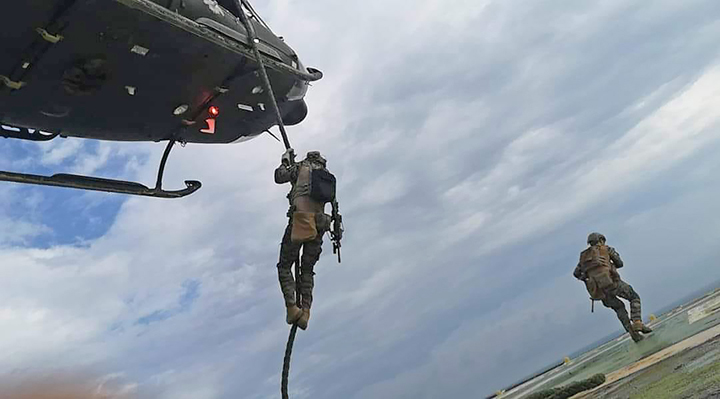
WESCOM said a “fast rope insertion and extraction system” (FRIES) was also performed where troops are inserted to and extracted from the platform using the Bell 412 combat utility helicopter and ropes.
FRIES is a specialized mechanical system that enables rapid tactical insertion and extraction of personnel in areas where helicopter landings are not permissible.
The same training event was conducted by the Philippines and US militaries on Wednesday, April 19.
“Wescom, through Joint Task Force Malampaya, will continue to sharpen its sphere in protecting and securing the country’s economic crown jewel, the MNGPP,” it added.
Meanwhile, PAF spokesperson Col. Ma. Consuelo Castillo said the exercise’s objective was to develop mutual defense capability and strengthen the country’s maritime security.
“The demonstration involved the protection of a retired Matinloc platform, which served as a stand-in for the Malampaya platform. The Bell 412 helicopter facilitated the vertical insertion of the elite assault troops from the Naval Special Operations Unit (NAVSOU) through FRIES,” she added.
This year’s Balikatan, scheduled from April 11 to 28, is the 38th iteration of the annual military exercise between the Philippines and the United States.
Around 17,680 combined troops from the Armed Forces of the Philippines (AFP) and the US military are taking part in this year’s exercises.
Aerial gunnery, replenishment drills
MEANWHILE, participating Filipino and American naval ships in this year’s Balikatan exercises conducted aerial gunnery and replenishment-at-sea exercises off Brooke’s Point town in Palawan on April 14.
Naval Forces West (NFW) chief Commodore Alan M. Javier, in a statement, said these drills took place shortly after the amphibious raid in Barangay Samariñana, Brooke’s Point, on Friday, April 14.
Naval vessels that took part in these exercises are the guided missile frigate, BRP Jose Rizal (FF-150), landing dock BRP Tarlac (LD-601), and the Wasp-class amphibious assault ship USS Makin Island (LHD-8).
“FF-150 and LHD-8 performed the aerial gunnery exercise, while all three ships performed the replenishment-at-sea,” Javier said.
The aerial gunnery exercise simulated an aerial contact, which the participating naval vessels will have to detect and engage.
While replenishment-at-sea is the conduct of refueling and reprovisioning by other vessels while underway, both exercises must be performed with precision and coordination.
“After the performance of the said exercises, the three ships will group sail en route back to Zambales for other activities and exercises scheduled thereat,” Javier said.
Amphibious raid exercise
EARLIER, NFW announced that joint Philippine and US forces have successfully conducted an amphibious raid exercise in Palawan also on April 14.
The exercise was also held at the beachhead of Barangay Samariñana in Brooke’s Point, Palawan.
“Following the arrival of the surface assets in Palawan [on April 14] an amphibious raid exercise was performed at the beachhead of Barangay Samariñana, Brooke’s Point, Palawan,” Javier said.
Different units highlighted this capability, namely, BRP Jose Rizal, BRP Tarlac, amphibious assault vehicles, Marine amphibious ready units and Marine reservists.
The US forces, meanwhile, employed their force reconnaissance platoon.
“Amphibious raids are usually performed against the enemy. It is accomplished by employing a special force into an area that is controlled by enemy forces. Amphibious raids are commonly quick and swift, leaving minimal footprints on the ground,” Javier said.
IN a related development, Wescom reported a significant increase in its maritime and aerial patrols in the West Philippine Sea (WPS) for the first quarter of this year.
“The AFP Wescom reports a substantial increase in its operational tempo, or ‘optempo,’ in the WPS for the first quarter of CY 2023. This means that more government ships are staying out at sea for longer periods of time and government aircraft flights over WPS have become more frequent,” Wescom chief Vice Adm. Alberto Carlos explained in a statement.
This initiative of Wescom is in line with President Ferdinand R. Marcos Jr.’s announcement that not a square inch of Philippine territory will be lost under his watch.
“Together with our partner agencies—the Philippine Coast Guard, the Philippine National Police Maritime Group and the Bureau of Fisheries and Aquatic Resources—the Philippine Navy established a strong maritime presence in the area with the sustained deployments of their respective ships in WPS, especially in the vicinity of Pagasa Island,” Carlos stressed.
These efforts are meant to counter the increased presence of suspected foreign militia vessels in the area, the Wescom chief pointed out.
It also boosted the number of its maritime air patrols to closely monitor the activities of foreign vessels in the WPS and the developments on foreign-occupied features in the area.
“Good weather and the availability of surveillance aircraft from the Philippine Air Force and our partner agencies allowed Wescom to have a comprehensive, accurate and timely maritime domain awareness picture in the WPS,” he added.
Carlos estimates that the increased optempo is about 50 percent above 2022 figures.
Image credits: Philippine Air Force, AFP Western Command