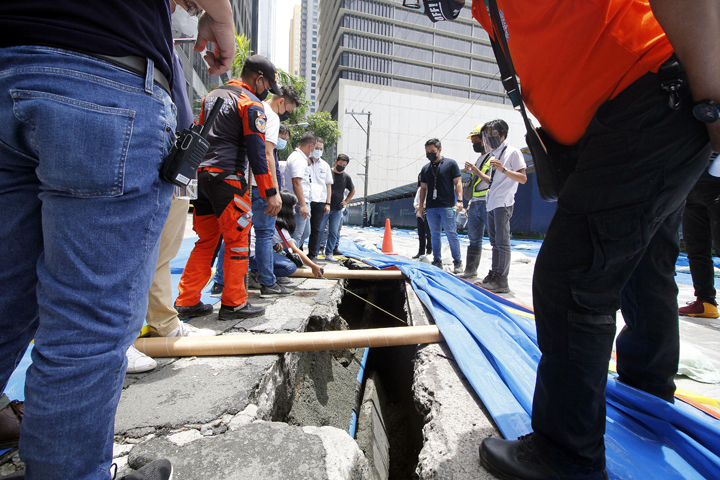

PASIG City Mayor Victor Ma. Regis Nubla “Vico” Sotto has ordered the City Engineer’s Office to submit their “full assessment” after cracks appeared on a portion on Topaz Road in Ortigas Business District at the height of severe thunderstorms and heavy rains on Sunday night.
Initial interviews with experts, however, ruled out the possibility that the cracks were caused directly by a lightning strike, or by a movement in earthquake faults.
The road was ordered closed to motorists as barricades were placed on Topaz Road between the corners of Opal and Garnet Roads.
“Our engineers are working with Ortigas Land, Manila Water, Meralco, and the barangay to pinpoint the cause of the damage along Topaz Road,” Sotto said in a tweet on Monday.
Sotto added, “They will finish submit their full assessment by today [August 23].”
A video went viral earlier showing the long crack, and many netizens wondered aloud if this was caused by the thunderstorm.
Lightning hitting ground? Not likely
A bolt of catastrophic lightning hitting the ground, enough to cause a crack in a city full of buildings, is not likely, according to Ariel Rojas, weather forecaster at the Philippine Atmospheric, Geophysical, and Astronomical Services Administration (Pagasa).
“Definitely it was not caused by lightning. Because in a city, the first thing that will be hit by lighting is the tallest structure in that area, not the ground. So it is impossible,” says Rojas.
“There are other explanations for that crack but that was not caused by lightning,” he reiterated.
While thunder and lightning depends on the severity of the thunderstorm, he said its impact could not cause a huge crack on the ground.
A bolt of lightning can kill a man or an animal as reported in the media in the past, but this is because the person or the animal was standing tall in the plains of a grassy area or rice field, making them the likely target.
During the monsoon months, severe thunderstorms are frequent. The ones observed in the areas of Cavite and National Capital Region (NCR), he said, are natural, especially because the Philippines is archipelagic, surrounded by bodies of water, that likely help buildup of weather disturbance, like thunderstorms, tropical storms, or worse, typhoons.
Not a fault–Phivolcs
A fault movement was also raised as a possibility, but the Phivolcs ruled this out.
Department of Science and Technology (DOST) Undersecretary Renato Solidum said: “First of all, there’s no fault [passing] in that area. And if there’s a fault, a crack like that could not happen without an earthquake,” Solidum, the concurrent Director of the Philippine Institute of Volcanology and Seismology (Phivolcs) told the BusinessMirror.
Meanwhile, a barangay official in the Ortigas area affected by the long road cracks said residents and workers of the four buildings near the cracks will not be evacuated.
“There will be no evacuation. So far, there’s no danger,” said Chairman Raymond Lising, of Barangay San Antonio. He said authorities are looking into soil erosion as a possible reason.
Lising joined Sotto, city hall officials, personnel of DPWH, Meralco, and Ortigas Land in inspecting the affected area.
Soil erosion
“Our initial findings showed that soil erosion could have caused the cracks. Yesterday, it was raining very hard here,” Lising told media, adding that thunderstorms brought heavy rains in Metro Manila on Sunday, leaving some areas flooded.
He added that the construction site near the affected area were ordered to temporarily stop their operations.
“But they will still help with the investigation on this matter,” he added.
The barangay official also appealed to the public not to panic.
“We are appealing to everyone not to panic. But we must always remain vigilant and alert at all times,” he said.
Solidum said based on the video and photographs he observed, the crack on the pavement on Topaz road could have been caused by soil erosion.
It is possible that the problem was caused by a leak in the drainage system.
“If you can see, there was a cover in a controlled area [where the crack appeared.] And there’s a strong water pressure so possibly, it was caused by possibly a leak in the drainage system that caused the soil to erode,” he explained.
Image courtesy of Roy Domingo