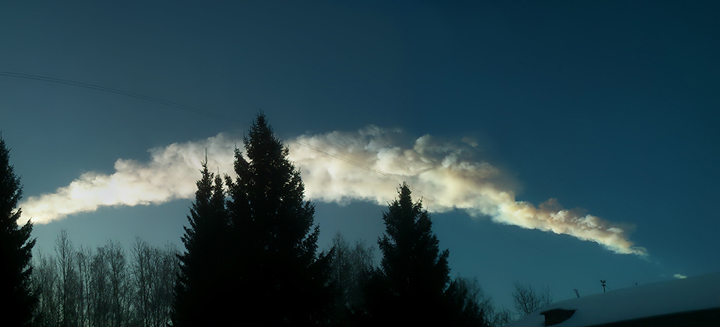
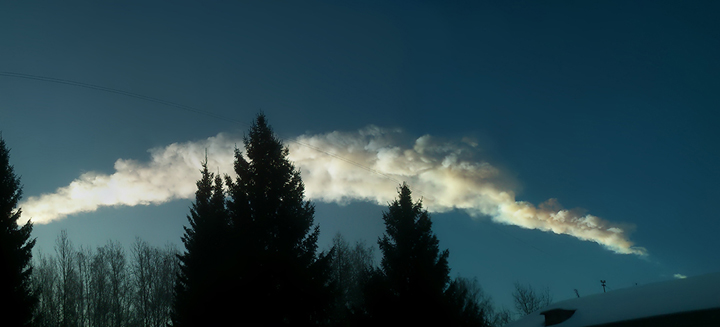
THE Russia incident was a warning. On a winter morning in 2013, a meteor the size of a four-story building screamed across the country, exploding near the city of Chelyabinsk and injuring more than 1,600 people amid widespread property damage.
The chunk of rock and iron, which was 60 feet across, served as a violent reminder that Earth, bombarded daily with tons of space-going debris, periodically intersects with large planet killers—and a significant portion of those remain undocumented.
After years of study and discussion, Nasa has launched its first effort to spare Earth the kind of calamity that extinguished the dinosaurs, crashing a space probe into an asteroid to alter its speed and course. The Double Asteroid Redirection Test (DART) lifted off November 23 local time aboard a SpaceX rocket from California and will cruise for 10 months to a binary asteroid system.
Adequate time to react
THE idea is that if humans have adequate time to react—decades of notice being preferable—enough energy can be transferred into a speeding rock to alter its trajectory and make it miss Earth, avoiding catastrophe up to and including an extinction-level event. (Though a popular subject in science fiction, it’s worth noting that Nasa’s current toolkit of asteroid-nudging techniques does not include Morgan Freeman, Bruce Willis or nuclear weapons.)
Given the critical nature of the work, it’s “not a stretch to suggest that DART may be one of the most consequential missions ever undertaken by Nasa,” Casey Dreier, an analyst with The Planetary Society, wrote in a November memo to members.
“This test is to demonstrate that this technology is mature enough so that it would be ready if an actual asteroid impact threat were detected,” Lindley Johnson, Nasa’s planetary defense officer, said at a November 4 news conference.
In September of next year—if all goes as planned—the DART craft will target Dimorphos, the smaller, 530-foot rocky body gravitationally tied to the larger Didymos, which is almost 2,600 feet across. The two rocks travel about 1 kilometer (0.6 mile) apart, and Dimorphos orbits its larger sibling every 11 hours and 55 minutes, “just like clockwork,” Johnson said.
Traveling at about 15,000 mph, the craft, which weighs 1,344 pounds and is 59 feet across, is to collide head-on with Dimorphos to both slow the rock by a fraction of a second and to adjust its orbital period around the larger asteroid by several minutes.
“It’s all about measuring the momentum transfer: How much momentum do we put into the asteroid by hitting it with the spacecraft?” said Andy Cheng, lead investigator for the mission at Johns Hopkins University’s Applied Physics Laboratory, which built and manages the spacecraft.
Didymos was discovered 25 years ago and has been well analyzed (insofar as asteroids and comets go). Its course isn’t predicted to meet Earth in the future, but its relatively close trajectory gives scientists a good test platform to observe with telescopes from about 6.8 million miles away.
The ‘weapons’
DART will use laser targeting and other high-resolution technologies to autonomously choose its impact point. As it races toward the rock, the craft’s camera will send images back to Earth. A small cube-satellite released from the main craft before impact will also record images from a safe distance. One big unknown: The smaller body’s surface composition and topography, which are too small to ascertain from Earth.
For more than 15 years, Nasa has been under Congressional orders to catalog near-Earth objects (NEOs) larger than 140 meters (460 feet), the size at which an asteroid strike would cause enormous devastation. “While no known asteroid larger than 140 meters in size has a significant chance to hit Earth for the next 100 years, less than half of the estimated 25,000 NEOs that are 140 meters and larger in size have been found to date,” according to Nasa’s Planetary Defense Coordination Office.
The 2013 Chelyabinsk incident caused Washington to take notice, with funding for planetary defense rising by more than 4,000 percent to $200 million annually over the past decade, thanks to ample support from both the Obama and Trump administrations, Dreier said.
Daunting challenge
THE challenges for spotting these potential planet killers are daunting, however. Earth-based telescopes are limited in range, objects approaching from the direction of the sun can’t be seen, many asteroids reflect almost zero light, and all travel ludicrously fast—43,000 mph or 12 miles per second, on average.
Moreover, not all are local. In 2017, astronomers spied the first large visitor from outside the solar system, a 400-meter, cigar-shaped oddity called Oumuamua that looped around the sun at a blistering 196,000 mph on its way back out into interstellar space.
Nasa plans additional testing of its trajectory-altering techniques once it has data from DART’s destruction at Dimorphos, assuming the mission is successful.
A “gravity tractor” is another idea under active consideration, the concept being to attach a spacecraft to an asteroid to enlarge its mass and slowly change its orbit.
Still, observation is critical to preventing a repeat of the fate that befell the dinosaurs. Nasa and other scientists are laboring under last year’s loss of the Arecibo Observatory in Puerto Rico, which played a key role in radar assessments of near-Earth objects, helping researchers to determine their size and orbits. Says Johnson, the earth’s defender at Nasa: “The key to planetary defense is finding them well before they are an impact threat.”
Image courtesy of Tatiana Nikitina | Dreamstime.com