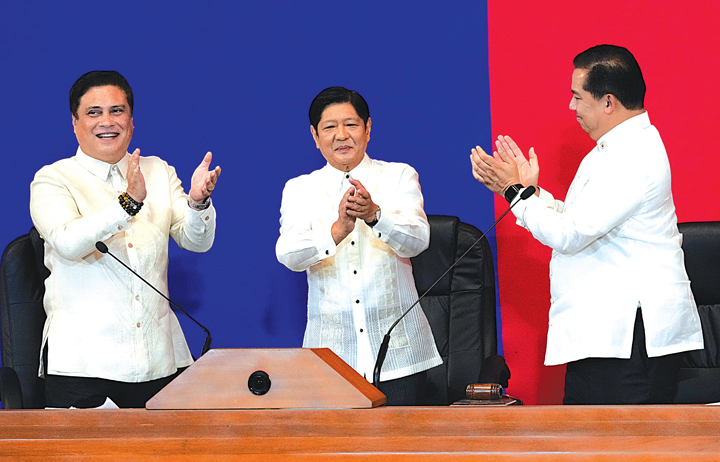
PRESIDENT Ferdinand R. Marcos Jr. committed to keep spending as much as 6 percent of the country’s GDP for infrastructure development, driven by its goal of linking not only the three major island groups but “all prospective sites of economic development.”
In his second State of the Nation Address (SONA), Marcos said the government has beefed up its infrastructure development program with the addition of 123 new projects into the Build, Better, More (BBM) Program.
“We are not just continuing what has been started, but we are expanding the portfolio,” he said.
An offshoot of the Build, Build, Build (BBB) Program of the Duterte administration, the BBM program covers flagship investment projects in areas of physical connectivity, water resources, agriculture, health, digital connectivity, and energy.
Marcos said 83 percent of the program involves investments in physical connectivity.
“Physical connectivity infrastructure such as roads, bridges, airports, seaports, and mass transport account for 83 percent of this program. Our infrastructure spending will stay at five to six percent of our GDP. The underlying logic to our infrastructure development is economic efficiency. We are opening up all gateways to mobilize goods and services at less cost with less time and ultimately drive the economy forward. Our road network plans must link not only our three major islands, but all prospective sites of economic development,” he said.
He cited the 1,200-kilometer (km) Luzon Spine Expressway Network Program and the 90-km Mega Bridge Program as some of the crucial components of the BBM Program.
Marcos also highlighted the development of more than 4,000 kilometers of roads and 500 bridges across the country.
The President also stressed that airport and seaport developments are “crucial” in ensuring a connected Philippines.
Mass transport, he noted, is also a priority for this administration.
“We initiated several railway projects with a length of more than 1,000 km. Notably, the southern leg of the North-South Commuter Railway System is now in full swing. In a few years, travel from Pampanga to Laguna will be reduced from four hours to just two,” he said.
Lastly, creating a network of interconnected infrastructure systems will be the target of the Department of Transportation (DOTr) and the Department of Public Works and Highways (DPWH).
“Intermodal connectivity will also be a primary consideration. Roads, bridges, and mass transport systems will be interconnected. This network will provide access and passage to vital and bustling economic markets such as agriculture hubs, tourism sites, and key business districts,” Marcos said.
The BusinessMirror earlier reported that advocacy groups Move as One Coalition and AltMobility called on Marcos to develop a “transportation system,” an environment where all the modes of transportation are carefully coordinated with each other.
According to the two groups, the success of the reforms in the transport industry must be measured by how much the commuters have felt improvements—if any.
Image credits: AP/Aaron Favila