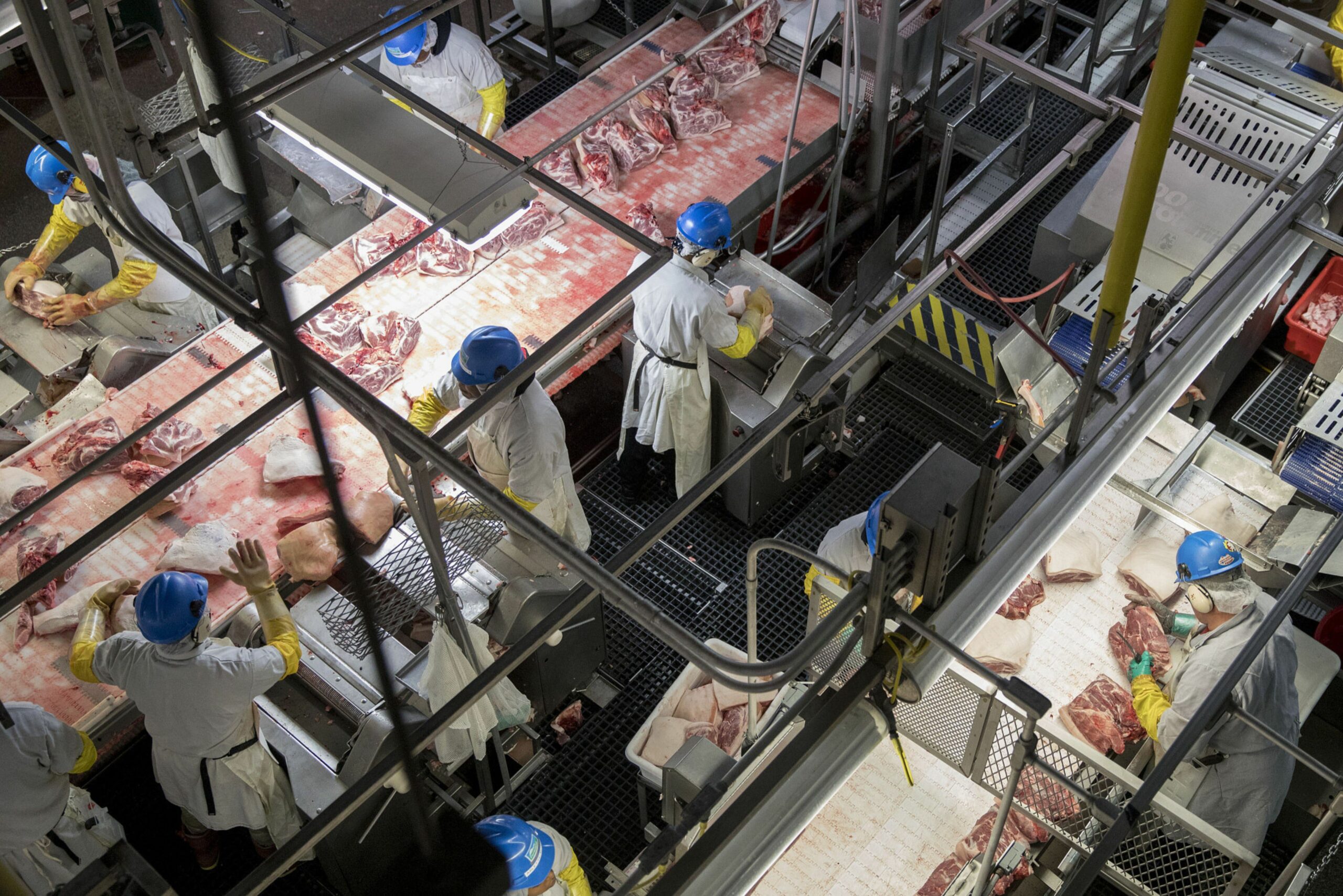
Pork exporters from Canada and Belgium are optimistic about increasing their shipments to the Philippines after Manila lowered tariff rates for imports and announced its plan to increase the minimum access volume (MAV) for pork.
Gary Stordy, Director of Government and Corporate Affairs of the Canadian Pork Council, told the BusinessMirror that Canada’s pork exports to the Philippines in January and February increased by more than fivefold.
Stordy said Canada exported about 27,000 metric tons (MT) of pork products to the Philippines during the two-month period, which was 485 percent higher than the 4,600 MT recorded a year ago.
He said the increase in exports was attributed to the availability of supply from Canada coupled by higher demand from the Philippines.
“Canada has products available if there is demand for it,” Stordy told the BusinessMirror in a recent interview.
Stordy said Canadian producers have been monitoring the pork supply situation in the Philippines since the country is their seventh top destination for pork products.
He also noted that high domestic pork prices do not always present an “opportunity” for exporters since there is a tendency among local consumers to shift to cheaper alternative protein sources.
“That is an equilibrium. If prices are too high in the domestic market, while it may appear as an incredible business opportunity, the individual consumer may diversify to choose alternative protein,” Stordy said.
“Right now we saw some increase in volume [in exports because] there’s a demand. Canada and other countries are just filling in some of the gaps [in domestic supply].”
Stordy said consumers ultimately benefit from a reduction in pork tariff rates, which the Philippines has recently undertaken, since it cuts the cost of imported products.
Bureau of Animal Industry (BAI) data showed that Canada is the country’s second top source of pork products, accounting for an average of 45,000 metric tons (MT) of imports. BAI data also indicated that Canada is the second biggest supplier of prime cuts of pork (bellies and pork cuts) to the Philippines.
Shipments of Canadian pork in the first quarter reached 26,047.031 MT, or half of what the country bought from Canada for the whole of 2020.
Belgian pork
The Belgian Meat Office (BMO) told the BusinessMirror that Belgian pork imports to the Philippines would recover this year. Belgium was unable to ship pork to the Philippines for two years due to problems created by African swine fever (ASF).
The Philippines imposed a temporary import ban on Belgian pork in October 2018 due to an outbreak of ASF. The ban was lifted last year.
BMO disclosed that it has “a serious number of contracts” with Philippine meat importers.
“Given the import demand, I think this year will make us forget quickly the fact that we’ve been out for two years. Already a serious number of contracts were signed and products are on sea or have already arrived,” BMO said in an e-mail interview.
BMO said the Philippines used to be Belgium’s second top destination for its pork products outside the European Union.
“Since the end of October last year, the ban on Belgian pork was lifted. We never really lost connection with our partners, we kept contact and trade resumed swiftly,” BMO said.
“The Philippine market is in need of protein; ASF has had devastating consequences in the Philippines and in other countries in the region. But our goal hasn’t really changed. Strong and lasting trade relations, allowing us to supply high quality products to people sharing a passion for pork.”
BMO noted that the reduction in pork tariffs by the Philippines “makes sense” given its domestic market conditions.
“Soaring retail prices, as they did, are destroying consumer confidence. Imported pork should therefore meet high quality standards. For us, it is key to convince our trading partners that that’s exactly what we can offer.”
BAI data showed that the country’s pork imports from Belgium in the first quarter reached 5,575.27 MT, of which 1,756.52 MT were prime cuts (bellies and pork cuts).
Agriculture Secretary William D. Dar said President Duterte may issue the new executive order (EO) implementing the compromised tariff rates on pork imports this week.
The DA disclosed last Wednesday that the tariff rates on pork imports would be increased by 5 percentage points. It also lowered the proposed MAV of 404,000 MT to just 254,210 MT.
With the compromise, the in-quota tariff rate for pork imports until July 7 would be 10 percent while out-quota would be 20 percent from the initial rates of 5 percent and 15 percent, respectively.
Tariff rates on pork from July 8 to April 7, 2022 under EO 128 would be raised to 15 percent for in-quota and 25 percent for out-quota imports.
Image courtesy of Daniel Acker/Bloomberg