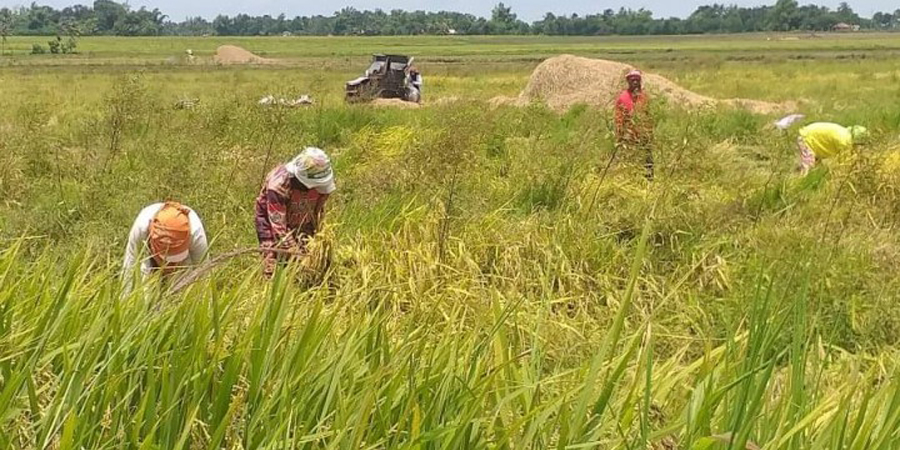
BACOLOD CITY – The Department of Agriculture-Negros Island Region (DA-NIR) has reported approximately PHP 40.96 million in rice and corn production losses due to the ongoing El Niño phenomenon as of Nov. 5, 2026.
Of the total, rice accounted for the biggest losses at PHP 36,667,309.10, while corn registered PHP 4,289,202.04 in damage.
Based on DA-NIR’s field assessment, the dry conditions affected 2,353 farmers and approximately 1,483 hectares of agricultural land, with reported production losses totaling 1,593 metric tons.
These figures remain subject to validation.
Rice production losses were reported at 1,366 metric tons, while corn production losses reached 195.35 metric tons.
The affected rice areas included 28.02 hectares in Binalbagan, 68.43 hectares in Cadiz City, 56.08 hectares in Escalante City, 822.74 hectares in Hinigaran, 100.60 hectares in Ilog, 20.87 hectares in Kabankalan City, 56.60 hectares in La Castellana, 8.61 hectares in Moises Padilla, 6.21 hectares in Sagay City, 53.17 hectares in San Carlos City, 114.77 hectares in Toboso, and 36.60 hectares in Don Salvador Benedicto, all in Negros Occidental.
For corn, the affected areas included 91.93 hectares in Toboso, Negros Occidental, and 18.45 hectares in San Jose, Negros Oriental.
Hinigaran recorded the largest affected rice area at 822.74 hectares, accounting for more than half of the total damaged farmland reported in the region.
The DA-NIR cited an earlier climate outlook issued by the Department of Science and Technology-Philippine Atmospheric, Geophysical and Astronomical Services Administration (DOST-PAGASA) during its 200th Climate Outlook Forum on Sept. 23, which indicated that a strong El Niño was present in the tropical Pacific.
In its latest advisory issued Nov. 4, PAGASA confirmed that a very strong El Niño was already present in the tropical Pacific.
The state weather bureau said the phenomenon was expected to persist until the first half of 2027, potentially reaching its peak before the end of 2026.
PAGASA also warned that most parts of the country could experience below-normal to way-below-normal rainfall in November, increasing the risk of dry spells and drought.
The provincial government of Negros Occidental remains optimistic that rice production, particularly in irrigated areas, will remain stable despite the expected prolonged effects of the El Niño phenomenon.
“Our goal is to ensure that Negros Occidental will continue to have an adequate supply of rice,” Gov. Eugenio Jose Lacson said. (Glazyl M. Jopson via tdg photo by tdg)