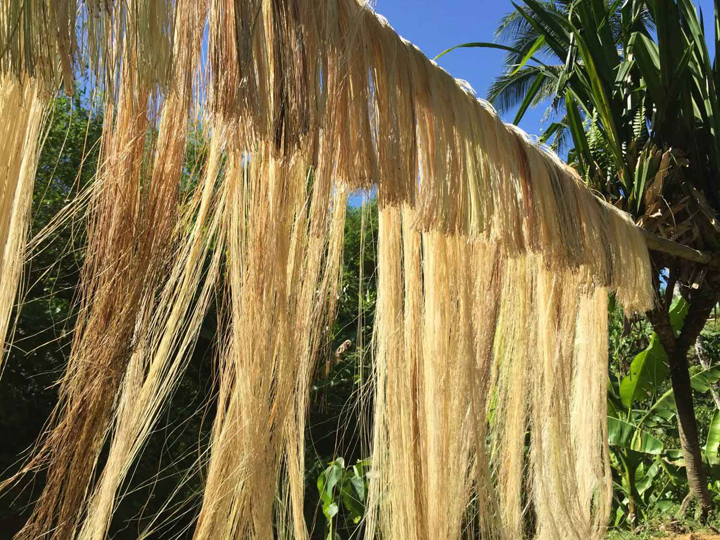
THE country’s abaca output this year is seen to further decline from last year’s 7-year-low as the industry reels from devastation caused by Typhoon Rolly (international name Goni), particularly in Catanduanes, the top producer of the natural fiber, the Philippine Fiber Industry Development Authority (PhilFida) said.
Nonetheless, PhilFida Executive Director Kennedy T. Costales told the BusinessMirror that they are implementing a P171-million rehabilitation and expansion program for the abaca industry this year.
“We are doing everything to rejuvenate the industry and in two years’ time we will return to the 70,000-MT production level or even exceed that volume,” he said.
Costales said PhilFida will implement an aggressive expansion of abaca plantation in the country this year using the P50-million fund reallocated by the Senate.
Documents obtained by the BusinessMirror showed that PhilFida plans to plant abaca on 1,100 hectares this year across 11 provinces.
Costales said they will put up abaca “plantations” in each of the identified provinces, with each plantation being contiguous and having an average size of 100 hectares.
Catanduanes is excluded from the P50-million expansion program of the PhilFida since it will have its own P121-million rehabilitation program.
Costales said the P121-million program for Catanduanes can rehabilitate about 8,000 hectares in the province. PhilFida data obtained by BusinessMirror showed that abaca production in Bicol Region, the largest abaca producer in the country, declined by 17.89 percent to 219,46.2 MT from 26,728.1 MT recorded in 2019.
Abaca production in Catanduanes declined by about 15 percent to 18,003.4 MT from the 21,068.1 MT recorded in 2019, PhilFida data showed.
Costales said this could be the lowest abaca output of the province in its history since its production level never dropped below 20,000 MT annually.
Despite the decline in output, Catanduanes remained top producer of abaca as it accounted for almost 30 percent of the total output last year.
Costales said recovery of abaca production in Catanduanes will take about 18 months to 2 years.
Likewise, it may take about two years before nationwide abaca output recovers to the 70,000 MT level, he added. Costales said he expects abaca output this year to further decline due to the damage and losses sustained by Catanduanes last year.
The BusinessMirror earlier reported that movement restrictions imposed by the government to stop the spread of Covid-19, coupled with the devastation caused by Rolly, pulled down the country’s 2020 abaca output to a 7-year low. (Related story: https://businessmirror.com.ph/2021/03/08/phl-abaca-output-falls-to-7-year-low/)
PhilFida data obtained and analyzed by the BusinessMirror showed that abaca production last year declined by 11.94 percent to 61,491.67 metric tons (MT) from the 69,828.8 MT recorded in 2019.
Historical PhilFida data, dating back to 1980, showed this is the lowest abaca output by the country since the 55,958 MT recorded in 2013.
Data also showed the nationwide production of the natural fiber was below 70,000 MT for the second consecutive year.
Costales said movement restrictions imposed last year amid the Covid-19 pandemic hampered the trade of abaca nationwide. This was made worse by Typhoon Rolly, which battered Catanduanes in November last year, as the province is the country’s top producer of abaca, Costales added.
“Catanduanes looked like it was hit by a nuclear bomb. I went to Bato, Catanduanes and the mountains are really brown, all abaca were uprooted,” Costales said.